
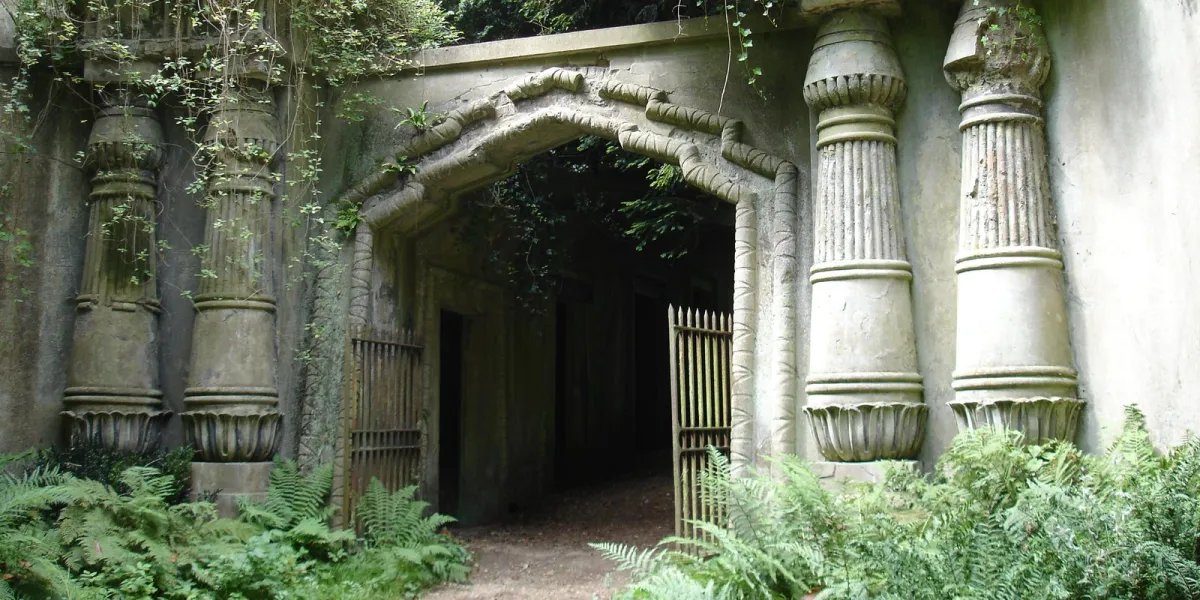
Most cemeteries lay out their graves in rows on open ground. Some of the best-known cemeteries in Europe and North America also bury their dead underground. Families bought shelves in brick tunnels, and one Bohemian church holds the bones of tens of thousands of people.
All fifteen cemeteries below, each with catacombs, crypts, burial vaults or an ossuary, are in the EveryStone archive. You can visit most of them, though the underground parts often open only for guided tours a few days a year.
Catacomb, crypt, vault or ossuary?
The words overlap, and cemeteries use them loosely.
- Catacomb: a gallery of underground passages with niches or shelves for coffins. The early Christian catacombs of Rome gave the word its meaning. Victorian cemeteries borrowed it for brick tunnels where families bought space for a coffin instead of a grave.
- Crypt: a burial chamber under a church or chapel floor.
- Burial vault: a chamber for one family, above or below ground, often closed by an iron door.
- Ossuary: a building or room for bones exhumed from graves, so the ground can be reused.
Green-Wood Cemetery, Brooklyn
Green-Wood Cemetery opened in 1838 as one of the first rural cemeteries in the United States. The cemetery holds about 600,000 graves on 478 acres and also serves as an arboretum. In the early 1850s the cemetery built a corridor of 30 family vaults into a hillside, lit by small skylights you can see from the slope above. Vaults like these cost a family less than a private mausoleum. Ward McAllister, who drew up the guest list for Gilded Age New York society, rests there. The catacombs stay locked between occasional tours and concerts that Green-Wood runs.
Highgate Cemetery, London
The West Cemetery at Highgate opened in 1839 to designs by the architect Stephen Geary, and it holds three underground features in a row. Egyptian Avenue, entered through an arch between columns with lotus capitals, is a sunken passage lined with family vaults that each hold up to twelve coffins. It leads to the Circle of Lebanon, a ring of vaults dug around an old cedar tree; the cemetery planted a new cedar in 2019 after the original decayed. Above them run the Terrace Catacombs of 1838 to 1839, which Historic England lists as the oldest surviving continuously asphalted structure in England. You can see all three on the West Cemetery's guided tours.
Kensal Green Cemetery, London
The first of London's "Magnificent Seven" commercial cemeteries, Kensal Green, opened in 1833 and took Paris's Père Lachaise as its model. Beneath the Anglican Chapel lies Catacomb B, which the London Gardens Trust calls the largest working catacomb in the country, with room for about 4,000 coffins. The coffin lift that lowers the dead from the chapel floor into the vault came from the engineers Bramah & Robinson in 1844. It was restored to working order in 1997 and can still carry a coffin.
West Norwood Cemetery, London
West Norwood opened in 1837, designed by William Tite, and it inspired Kensal Green's lift. Its own hydraulic catafalque of 1839 lowered coffins in silence from the Episcopal chapel to the catacombs. Only its top platform moved, and it could swivel, so bearers below could take the coffin off. The chapel was demolished in the mid-20th century and a rose garden now covers the spot, but the brick vaults below survived intact. Subterranea Britannica has photographs of the passages and the lift.
Brompton Cemetery, London
Catacombs run behind cast-iron doors beneath the long colonnades of Brompton Cemetery, which flank the central avenue and the Great Circle. The cemetery opened in 1840, holds more than 200,000 burials on 39 acres, is Grade I listed and belongs to the Crown. The Royal Parks manage the cemetery, and volunteers of the Friends of Brompton Cemetery open a lit section of the catacombs for short tours a few times a year.
Warstone Lane Cemetery, Birmingham
The builders of Warstone Lane in the Jewellery Quarter turned the walls of a former sand quarry into catacombs when the cemetery opened in the late 1840s. The vaults form a tiered semicircle, an amphitheatre of iron doors that once linked to a chapel above. After bomb damage in the Second World War, the chapel came down in the 1950s. More than 90,000 people lie there. The Jewellery Quarter Cemeteries Project has restored the catacombs since 2019, and you can visit neighbouring Key Hill Cemetery on the same walk.
Capuchin Catacombs, Palermo
The friars of the Capuchin convent in Palermo began laying their dead in vaults beneath the convent in 1599, starting with Brother Silvestro of Gubbio. Over three centuries the city's clergy, nobles and merchants paid to join them, dried and dressed in their own clothes. The provincial tourism office of Palermo puts the total at about 8,000 bodies, and researchers have catalogued more than 1,200 mummified remains. The best known is Rosalia Lombardo, a two-year-old embalmed in 1920 by Alfredo Salafia. Stories that she opens her eyes come from light falling through a side window. Above ground, the Capuchin Cemetery holds the politician Michele Amari and other Sicilian figures.
Sedlec Ossuary, Kutná Hora
The cemetery around the Church of All Saints at Sedlec became a coveted place to be buried after an abbot of the Cistercian monastery, according to tradition, scattered earth from Calvary over it. Victims of plague and the Hussite wars filled it, and the bones of the exhumed went into the chapel below. In 1870 the Schwarzenberg family hired the woodcarver František Rint to arrange them. His chandelier, garlands and Schwarzenberg coat of arms use the bones of 40,000 to 70,000 people, according to the estimates most often cited. Kutná Hora's town burial ground, All Saints Cemetery, is a separate site in the Žižkov district.
St. James Cemetery, Weimar
The Jacobsfriedhof is Weimar's oldest surviving burial ground, and Lucas Cranach the Elder is buried there. In the early 18th century a state bursar built a family vault at its south-eastern edge, the Kassengewölbe, which later served citizens of rank who had no grave of their own. Friedrich Schiller was laid there at night in May 1805. When the vault closed in 1826 it held 64 people, and a skull taken as Schiller's went to the Ducal Vault. DNA tests from 2006 to 2008 showed it belonged to someone else. The Klassik Stiftung Weimar looks after the vault, rebuilt in 1927 on its old walls.
St. Peter's Cemetery, Salzburg
St. Peter's Cemetery lies inside St. Peter's Abbey and has seen burials since about 700; its oldest tombstone dates from 1288. Behind the arcaded graves, steps lead into chambers cut into the cliff of the Mönchsberg. Historians disagree on how old these "catacombs" are and how many people were ever buried in them. The Gertraud Chapel, 48 steps up, was consecrated in 1178.
Fontanelle Cemetery, Naples
Fontanelle Cemetery fills a cave of more than 3,000 square metres cut into the tuff hillside of the Sanità district. From about 1600, when the churches of Naples ran out of room, the remains of the city's poor came here, joined later by victims of the plague of 1656 and the cholera of 1836. The city's tourism board puts the total above 40,000. In 1872 the priest Gaetano Barbati sorted the bones into the rows of skulls you see today. Neapolitans then began to adopt a skull, a capuzzella, cleaning it and asking for favours or lottery numbers in return, and grateful families gave "their" skull a small altar or a tin box. The archbishop banned the cult in 1969.
Hallstatt Cemetery, Austria
Hallstatt Cemetery sits on a narrow terrace above the Catholic parish church, between the lake and the mountain, with no room to grow. Graves had to be reused, and the bones went to the lower floor of St Michael's Chapel, a 12th-century building beside the church. From 1720 families painted the skulls with names, dates of death and wreaths of leaves and flowers, and stacked them by family. The Salzkammergut tourist board counts about 1,200 skulls in the bone house, 610 of them painted.
Powązki Cemetery, Warsaw
Powązki Cemetery opened in 1790 on land given by the nobleman Melchior Szymanowski, and Dominik Merlini designed its church of St Charles Borromeo the same year. Soon afterwards the cemetery built its catacombs: long walls of burial niches in tiers, where Warsaw's leading families placed their dead behind carved plaques. Chopin's parents, Mikołaj and Justyna, rest there. In 1925 the cemetery laid out the Avenue of Merit along the catacombs' southern wall. Most burial records from 1792 to 1944 burned with the cemetery office during the war, and a street collection held every November since 1975 has paid to conserve about 1,700 graves.
Skull Chapel, Czermna
In the churchyard of St Bartholomew's at Czermna, now part of the spa town of Kudowa-Zdrój in Lower Silesia, stands a small Baroque chapel lined with human bones. The parish priest Václav Tomášek, inspired by the Capuchin crypt he saw on a pilgrimage to Rome, began it in 1776. With the sacristan and the gravedigger he spent 18 years gathering the bones of people killed by the Thirty Years' War, the Silesian Wars, cholera, plague and hunger. About 3,000 skulls cover the walls and ceiling, and the crypt below holds the bones of another 21,000 people. The skulls of the men who built it, Tomášek among them, were placed on the altar in 1804.
Glasgow Necropolis
The Glasgow Necropolis holds about 50,000 burials on a hill east of Glasgow Cathedral. When it opened in 1833, its founders planned catacombs under the hill, reached through a single gateway that a guard could watch, because body snatchers were still selling fresh corpses to medical schools. The Anatomy Act of 1832 gave anatomists a legal supply, and the full scheme stayed on paper. Of the catacombs only the Egyptian Vaults of 1837 went up, designed by the architect John Bryce: a heavy gateway with a cast-iron gate, opening into vaults where coffins waited until a permanent grave was ready.
Before you go
- Book ahead: in London, Brooklyn and Birmingham the catacombs open only for guided tours. Check the Friends groups or the cemetery's own site for dates.
- Expect steps and dark passages: most tours have age limits and no step-free access.
- Respect the dead: many vaults still belong to families, and some catacombs still take burials.
You can find each of these cemeteries in the EveryStone archive, along with thousands of others in the United Kingdom, Italy, Poland, Austria and the United States.