
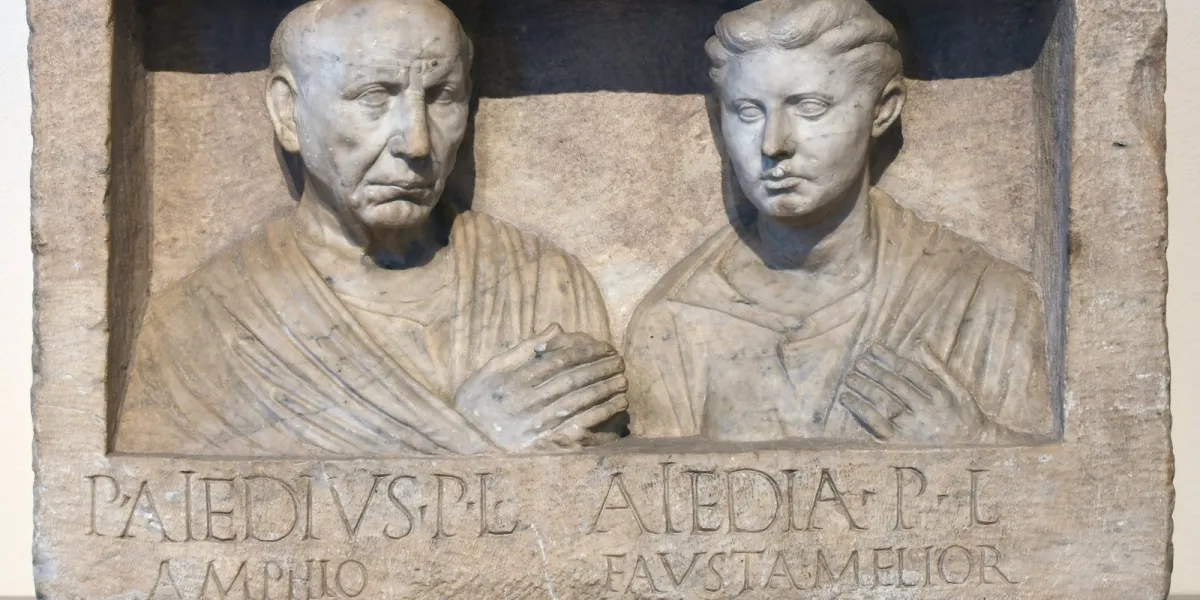
Walk through almost any cemetery in Slovakia, Ukraine or Lithuania and you pass row after row of double headstones: one surname, two first names, two sets of dates. The gap between the two death dates gives the years one partner lived on alone.
How we found the couples
We started with two kinds of pairs. In our archive, 80,336 photos show exactly two grave records, and 70,674 GPS points hold exactly two graves. The two lists overlap, and together they give 78,879 pairs of people who lie under one stone or at one spot.
Of those pairs, 55,191 share a surname. We counted the female forms that many languages use as the same name: Slovak and Czech add -ová (Novák and Nováková), Polish turns -ski into -ska, Ukrainian and Russian add -a, and Lithuanian gives a married woman -ienė (Kazlauskas and Kazlauskienė).
We then kept a pair only if the two were born within 15 years of each other, both birth and death years were recorded, the first names and surname forms point to one man and one woman, and both were at least 18 when the first of them died. The age rule removed 13,102 pairs with a larger gap, most of them a parent and child. We also set aside 104 Lithuanian pairs where the woman carries the unmarried form (-aitė, -ytė, -utė), which marks a daughter.
That left 32,627 likely couples: 12,289 in Slovakia, 3,726 in Lithuania, 2,779 in Czechia, 2,687 in Ukraine, 2,330 in Poland, 1,733 in the United Kingdom and 1,583 in Germany, with smaller numbers elsewhere. In 3,043 of the Lithuanian pairs the woman's surname ends in -ienė, the married form. In 598 pairs a woman is named in the Hungarian style with -né, which means "wife of": Istvánné is Mrs István.
Limits of the data
Our records hold no marriage dates. We cannot say which couples were married longest, only how far apart their deaths fell.
A shared surname on a shared stone does not prove a marriage either. Brothers and sisters, or a woman and her brother-in-law, can share a grave and fit our age rule. To measure this, we looked at the photos of 30 pairs chosen at random. Seven stones could not be read in the photo. Of the 23 we could read, 11 say outright that the two were a couple: "beloved wife of", Hungarian "és neje" (and his wife), Slovak "manželia" (spouses), a woman's maiden name after "rod." or "née", "dear parents", or children and grandchildren mourning them both. Another 11 read as a couple's stone without saying so, and one was unclear. None was a brother and sister or a parent and child.
We found most errors among the longest gaps. The three longest gaps among couples who both died before 2000 were not couples at all: a woman and her brother-in-law in Sweden, a brother and sister in Debrecen, and a man and his brother's wife in Havířov. Every couple named below we checked against the stone.
We miss couples where the second partner is still alive, so recent gaps look shorter than they will turn out. Keep in mind, too, that a small share of the records in our database may contain errors.
How long one partner outlived the other
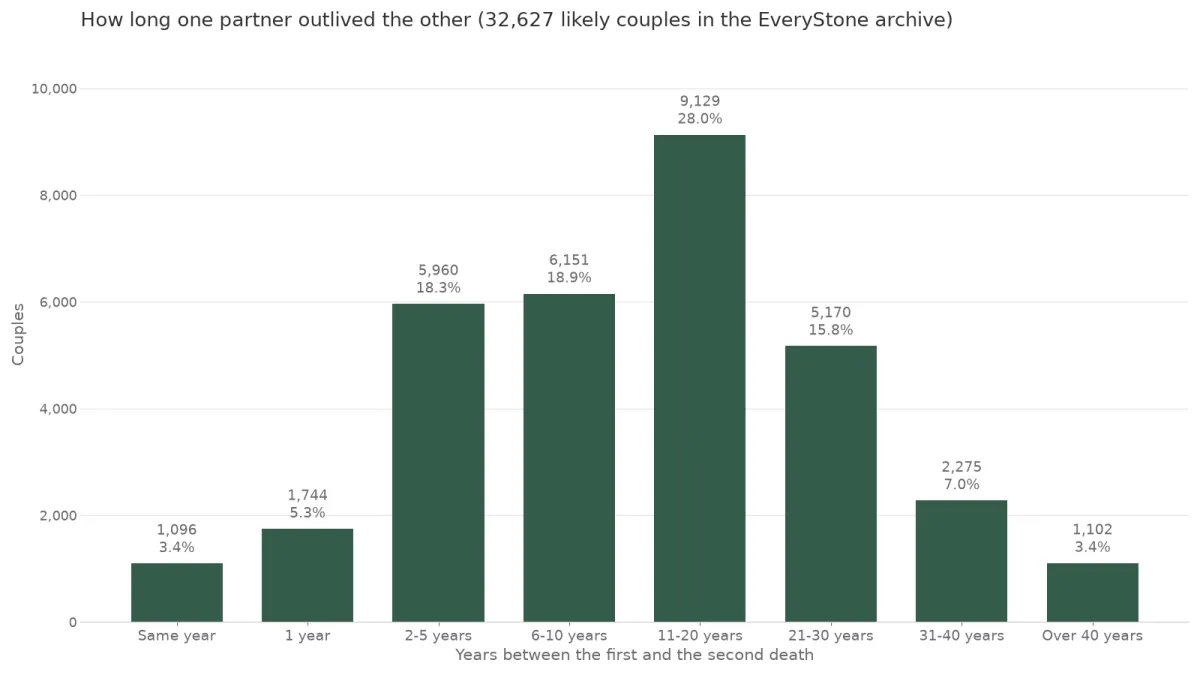
Years between the two death dates for 32,627 likely couples on shared stones in the EveryStone archive. "Same year" and "1 year" compare calendar years.
Half of all couples died 12 or more years apart, and the average gap is 14.4 years. The largest group, 28%, lies between 11 and 20 years. One couple in ten (3,377) was separated by more than 30 years.
At the other end, 1,096 couples (3.4%) died in the same calendar year and 1,744 (5.3%) in consecutive years.
Widows and widowers
In 22,146 couples (67.9%) the husband died first. In 9,385 (28.8%) the wife did, and 1,096 died in the same year. Part of the reason is age: the husband was older in 24,572 couples (75.3%), by a median of three years, and the wife was older in 5,581 (17.1%).
The widows also lived on longer. A woman who lost her husband lived a median 14 more years; a man who lost his wife lived a median 8.
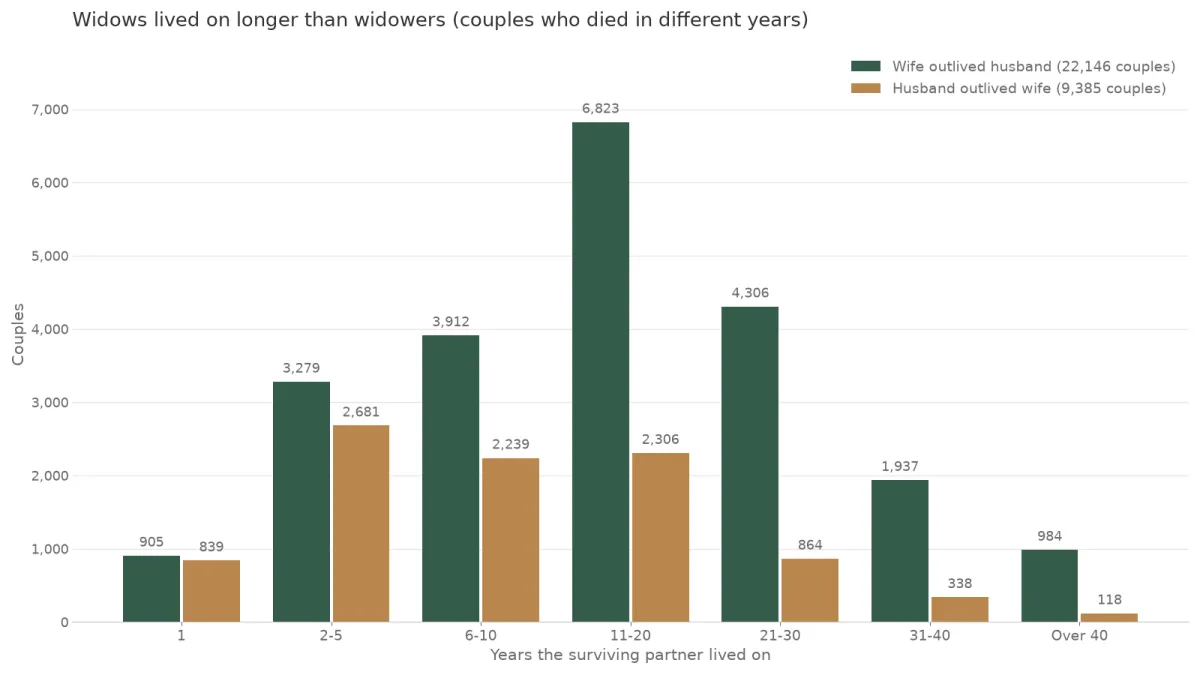
Couples who died in different years, by who died first and how many years the survivor lived on. Wives outlived husbands in 22,146 couples, husbands outlived wives in 9,385.
On many stones the two deaths fall a few years apart and the family remembers both together. In Brodno, near Žilina, the children of Žofia and Štefan Pažický called them their "dear parents": she died in 1966, he five years later. In Budky, in Ternopil Oblast, Hanna and Yakiv Hensiruk died in 1978 and 1982, and the stone says their children, grandchildren and great-grandchildren mourn them.
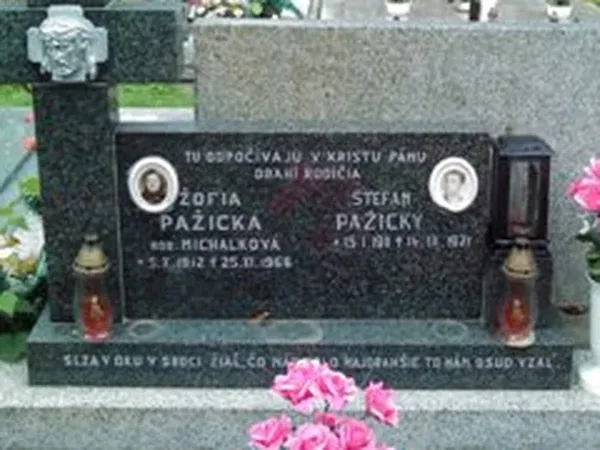

Left: Žofia Pažická (1912-1966) and Štefan Pažický (1911-1971), Brodno Cemetery, Žilina, Slovakia. Right: Hanna Hensiruk (1908-1978) and Yakiv Hensiruk (1906-1982), Budky Cemetery, Ternopil Oblast, Ukraine.
The longest gaps
The longest gap we could confirm on a stone is 64 years. Ivan Novosad died in 1915, aged about 36. His wife Teklia lived until 1979. Her stone in Potorytsia Cemetery in Lviv Oblast names her first and then, in a line of its own, "we remember her husband Ivan". The wording suggests he is commemorated there rather than buried with her.

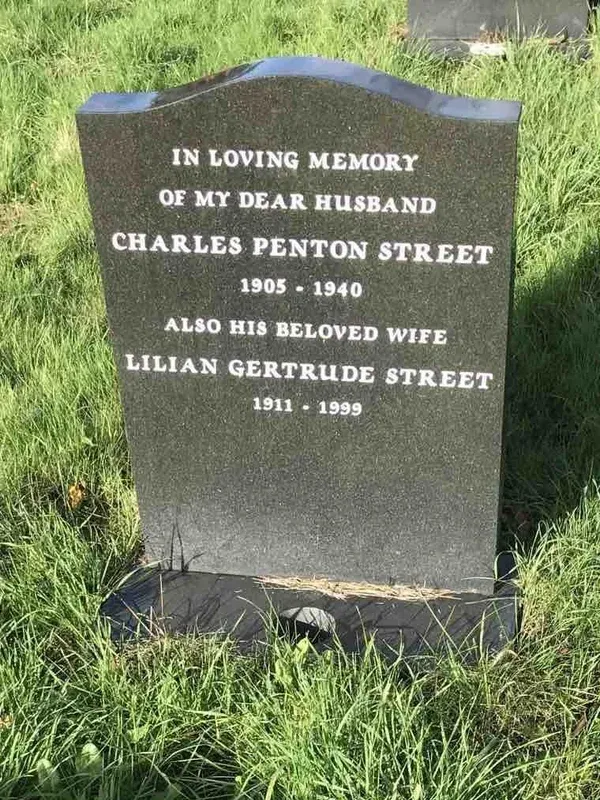
Left: Teklia Novosad (1886-1979) and Ivan Novosad (1879-1915), Potorytsia Cemetery, Lviv Oblast, Ukraine. Right: Charles Penton Street (1905-1940) and Lilian Gertrude Street (1911-1999), Saint Mary Extra (Butts Road) Cemetery, Southampton, United Kingdom.
In Southampton, Lilian Gertrude Street put up a stone "in loving memory of my dear husband" Charles Penton Street, who died in 1940, aged about 35. Her own name went under his 59 years later, as "his beloved wife". In Malmö, the stone of Otto Edvard Andersson calls him "my dearly loved husband". He died in 1918, and his wife Hilma joined him 58 years later, in 1976.
Couples who died close together
For 21,782 couples both full death dates are known, day and month included. Of those, 1,415 (6.5%) died within a year of each other, 202 within a month, 99 within a week, and 44 on the same day. Two of the 44 fall on 1 January, a date that often stands in for an unknown one.
Researchers call the higher risk of dying soon after losing a spouse the widowhood effect. Our numbers cannot separate it from shared causes such as an accident, a war or an epidemic, or from chance, so we only report them.
Hryhorii and Anastasiia Muliak of Velyka Solonka, in Lviv Oblast, were born a day apart, on 18 and 19 September 1907. They died two days apart, on 11 and 13 May 1990, and share one portrait stone.

Hryhorii Muliak (1907-1990) and Anastasiia Muliak (1907-1990), Solonka Village Cemetery, Velyka Solonka, Lviv Oblast, Ukraine.
In Plavecký Mikuláš, in the Trnava Region, a stone introduces "manželia Jozef a Paulína Ščepka", husband and wife, born in 1908 and 1914; both died on 30 November 1964. In Mýtna, Elena Balážová, née Šnúriková, and Juraj Baláž were born six months apart and both died on 22 April 1986.
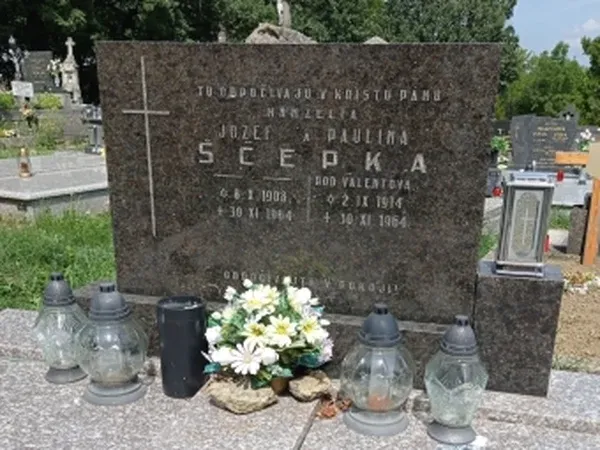
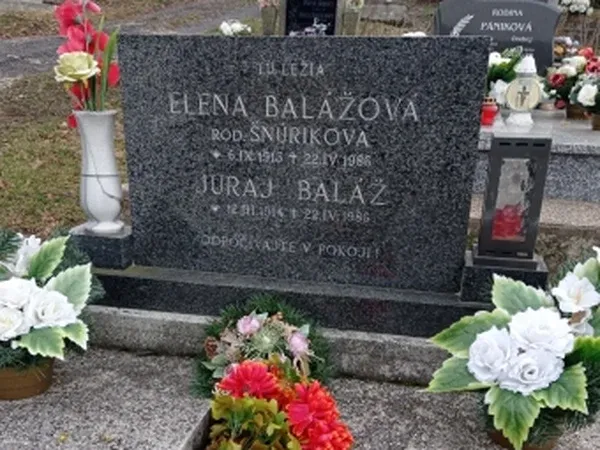
Left: Jozef Ščepka (1908-1964) and Paulína Ščepková (1914-1964), Plavecký Mikuláš Cemetery, Slovakia. Right: Elena Balážová (1913-1986) and Juraj Baláž (1914-1986), Mýtna Cemetery, Banská Bystrica Region, Slovakia.
The stone of Ján and Anna Edlman in Skalica Cemetery gives the reason. Ján, born in 1884, and Anna, born in 1890, "died tragically in an air raid on 10 April 1945". Their grandchildren added a line underneath: in our memories, grandad and grandma, you live with us.

Ján Edlman (1884-1945) and Anna Edlmanová (1890-1945), Skalica Cemetery, Skalica, Slovakia.
Reading a double stone yourself
Look for the words that mark a married couple: "wife of", "beloved husband", Slovak "manželka" and "manželia", Hungarian "neje", German "geb." or Slovak "rod." before a maiden name. Lithuanian families often write the surname in the plural, as in Šliažai or Kupečiai, "the Šliažas family". A second death date cut in a different hand or a brighter gilt can mean the stone stood for years with one name.
Most of our couples lie in Slovakia, Lithuania and Ukraine. If your grandparents share a headstone, you may find them there with both names and dates.