
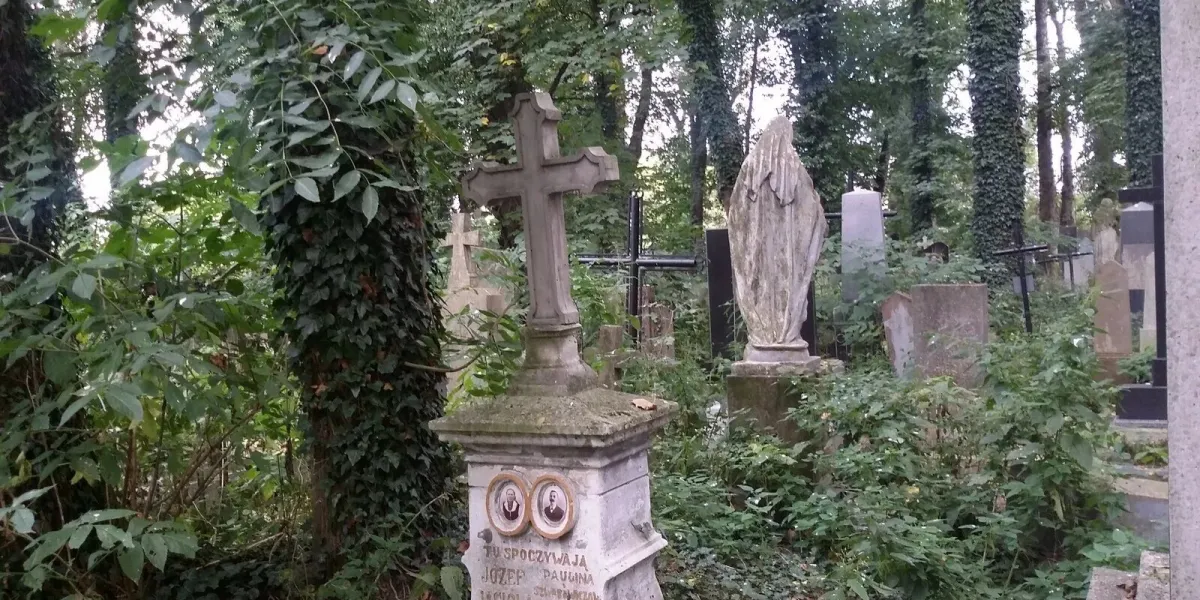
Most headstones say little: a name, two dates, sometimes a line of scripture. A few were made to be looked at for a long time. A stonemason spent weeks on an angel's feathers, a smith bent iron into spirals, a village painter gilded a saint above a child's name.
EveryStone holds hundreds of thousands of grave records, many with a photo of the stone. We went looking for the most beautiful of them, across countries and styles, and this is what we found.
How we chose them
We took every photo of a person who died before 1950, plus up to 1,500 random later photos from each country: 117,945 photos from 51 countries in all. An image model compared each photo with written descriptions of 14 kinds of memorial, from "a marble angel statue standing on a grave" to "an ornate wrought iron cross" and "a carved Jewish gravestone with Hebrew letters". It also scored how far each photo sat from a plain polished slab or a blurry snapshot.
Then we looked at the best 24 in each style ourselves. We dropped photos where the stone did not match the record, photos that showed someone else's tomb, and anything we could not read. Every person named below died before 2000.
The sample leans towards the places our photos come from: the United Kingdom, Czechia, Finland, Ukraine, Slovakia and Germany hold the most. Beauty is a matter of taste, so read this as a walk through the archive in no particular order.
Carved in hope: Orkney, 1688
The oldest stone on our list stands in Saint Magnus Cathedral in Kirkwall, founded in 1137, whose walls carry many carved 17th- and 18th-century memorials. The archaeologist behind the Spade & the Grave blog has surveyed its carved slabs in detail.
Nicola Trail died in July 1688, aged 33. Her slab reads "In hope of a blessed resurrection here rests Nicola Trail", and the carver set that hope in stone. A risen figure with a banner stands under an arch inscribed "Heaven opened", a crown floats beside it, and at the foot lie a skull and crossbones next to a globe marked "Vanitas". The carver put death at the bottom and the promise at the top.

Nicola Trail (1655-1688), Saint Magnus Cathedral, Kirkwall, Orkney.
Angels
Angels are the most common figure on the grand graves in our photos, and the hardest to carve well. The two we liked best stand in very different places.
Karl Septer's angel rises against a clear blue sky at Baikove Cemetery in Kyiv, one of the city's oldest burial grounds. She holds a heavy bunch of flowers to her chest, and her robe falls to her feet in long marble folds. Anna Kopecká's angel, in the small village cemetery at Nahořany in eastern Bohemia, holds a wreath above a black plaque listing the Kopecký family.

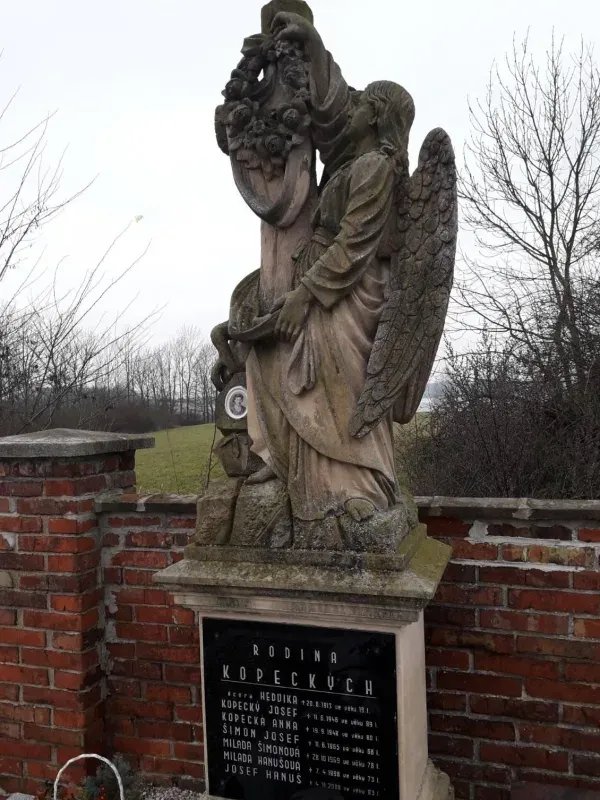
Left: Karl Septer (1854-1916), Baikove Cemetery, Kyiv. Right: Anna Kopecká (1868-1948), Nahořany, Czechia.
Mourners in stone and bronze
Some families chose a human figure instead of an angel: a mourner who keeps watch for ever.
At Olšany, Prague's largest cemetery, a stone man sits on the grave of Leopold Batěk in a jacket and cap, his hands folded on his knee. Prague's tourist board calls the Olšany cemeteries a collection of funeral art running from Classicism to the present, and this ordinary man in work clothes is one of its quieter pieces.
In Carei, in north-western Romania, a veiled marble woman leans against the column of József Szoboszlay P., who died in 1900. The Hungarian inscription on the Reformed cemetery's column closes with a blessing on his memory, "Áldás emlék…", its last letters hidden behind her veiled head.
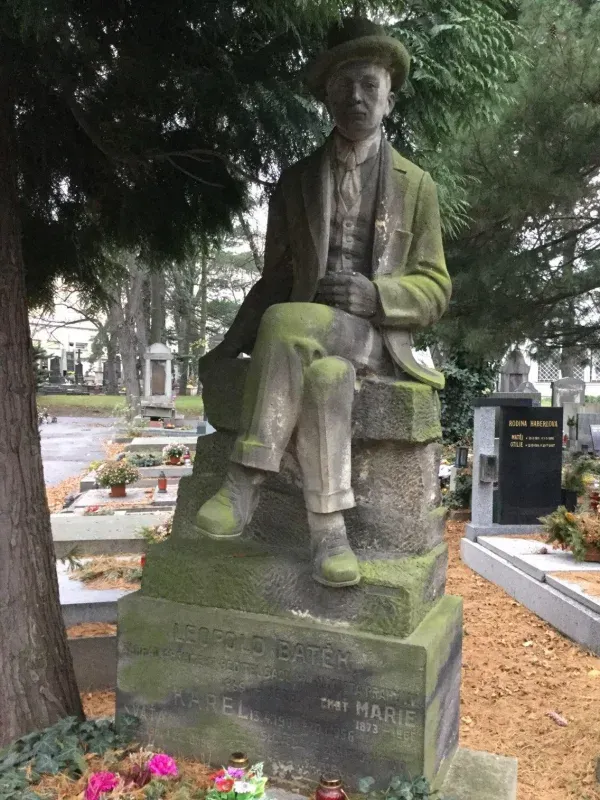

Left: Leopold Batěk (1869-1928), Olšany Cemetery, Prague. Right: József Szoboszlay P. (died 1900), Reformed Cemetery, Carei, Romania.
Bronze lasts where marble wears. At the Tolkewitz Urn Grove in Dresden, opened in 1911 when cremation was new in Saxony, a green bronze woman sits beside an urn on the grave of Alfred Grosse. In Berlin, at St. George Parish Cemetery IV, a bronze figure lies stretched along the foot of Brigitta Wiessner's stone. She died in 1933 at 21.
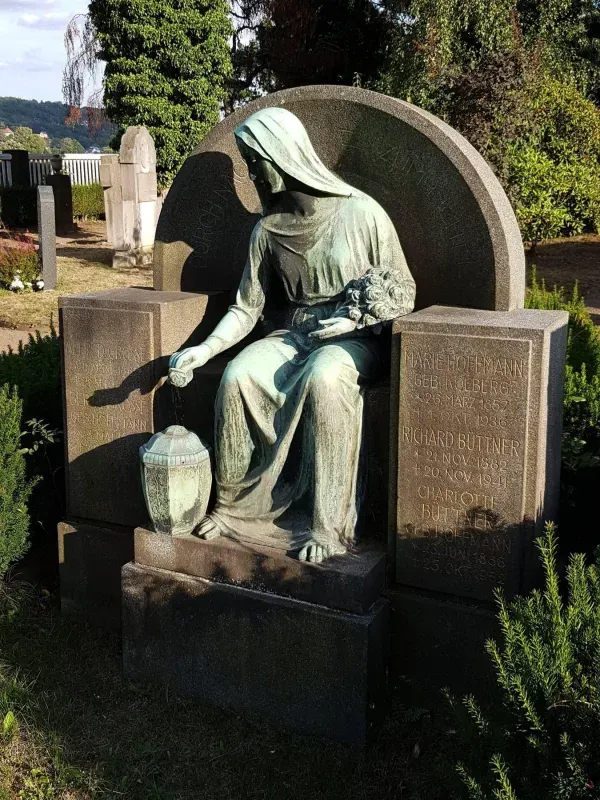
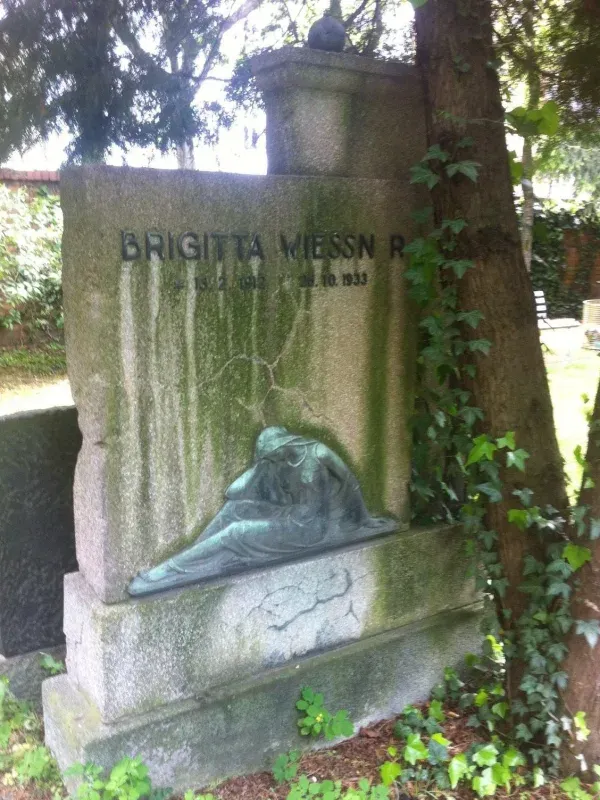
Left: Alfred Grosse (1880-1926), Tolkewitz Urn Grove, Dresden. Right: Brigitta Wiessner (1912-1933), Berlin.
Iron crosses
In the Alps and across central Europe, families marked graves with wrought-iron crosses for centuries. A good smith turned a plain cross into a lacework of scrolls, leaves and rays.
The Zauner family's cross stands in Hallstatt, the steep lakeside churchyard where space ran so short that bones were moved to the charnel house in St Michael's Chapel, where the painted skulls still sit. In Valašské Meziříčí in Moravia, Rudolf Schlattauer's cross spreads into broad iron spirals around an Alpha and Omega, with his name on a shield-shaped plate below.
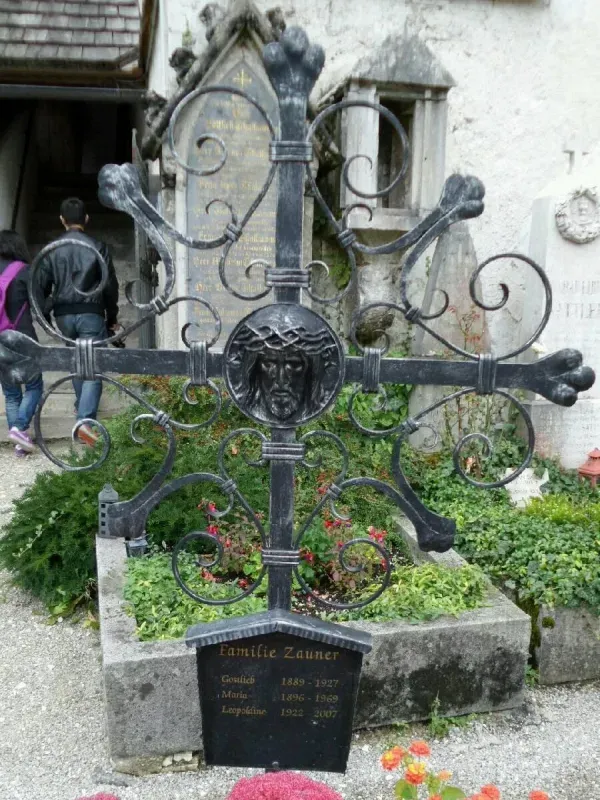
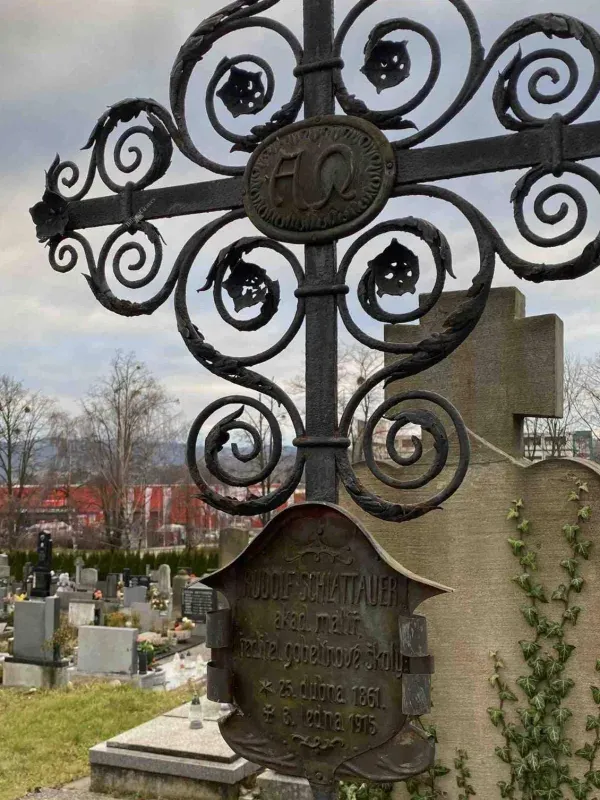
Left: Gottlieb Zauner (1889-1927), Hallstatt, Austria. Right: Rudolf Schlattauer (1861-1915), Valašské Meziříčí, Czechia.
In Finland the same idea arrived as cast iron. At Mäntyharju, a gilded cross marks the grave of Huco Richard Andersson, a boy who died in 1905 at the age of six. Its round centre plate and pierced arms catch the light on a summer lawn.

Huco Richard Andersson (1899-1905), Mäntyharju Cemetery, Finland.
Stone trees and painted saints
In the Polish cemetery in Zhytomyr, one of the oldest Polish burial grounds in Ukraine, Malwina Slawek's monument is carved as a tree trunk with lopped branches, topped by a cross of rough-barked stone. Across Europe and North America, carvers used the cut tree for a life ended early.
Further west, in the Volhynian village of Nekhvoroshcha, someone painted the Virgin and cherubs gold on the grave of Halyna Matviichuk, a girl of seven who died in 1944. The paint has peeled and the Cyrillic letters below are hard to read, but the gold still shines in the sun.


Left: Malwina Slawek (died 1905), Polish Cemetery, Zhytomyr. Right: Halyna Matviichuk (1937-1944), Nekhvoroshcha, Volyn region.
A Jewish stone in Bukovina
In Boiany, near Chernivtsi, the matzevah of Salomon Marcus stands between two carved columns under a Star of David. Lines of Hebrew fill the panel, framed by a band of zigzag ornament, and at the foot a German line reads "Hier ruht Salomon Marcus", here rests Salomon Marcus. He died in January 1902, when Bukovina was still an Austrian crown land.

Salomon Marcus (died 1902), Boiany, Chernivtsi region, Ukraine.
A Celtic cross in Surrey
The Celtic cross came back into fashion in Victorian Dublin, where copies of the old high crosses became fashionable cemetery monuments from the 1860s, and spread from there across Britain. The Venables family cross in the churchyard of St John the Evangelist, Coulsdon, shows the style at its best: a wheel head of interlace and a shaft wrapped in a single endless knot.

The Venables family cross, with their grandson Theodore Venables Hall (1901-1902), St John the Evangelist, Coulsdon, Surrey.
A face on the stone
From the late 19th century, photographs fired onto porcelain let families put a face on the grave. The custom never left Ukraine. At the old cemetery in Yavoriv, near Lviv, Ioan Bryttan looks out from an oval portrait framed by engraved laurel. He died in 1907 in his 93rd year, and the porcelain has kept his face clear for more than a century.
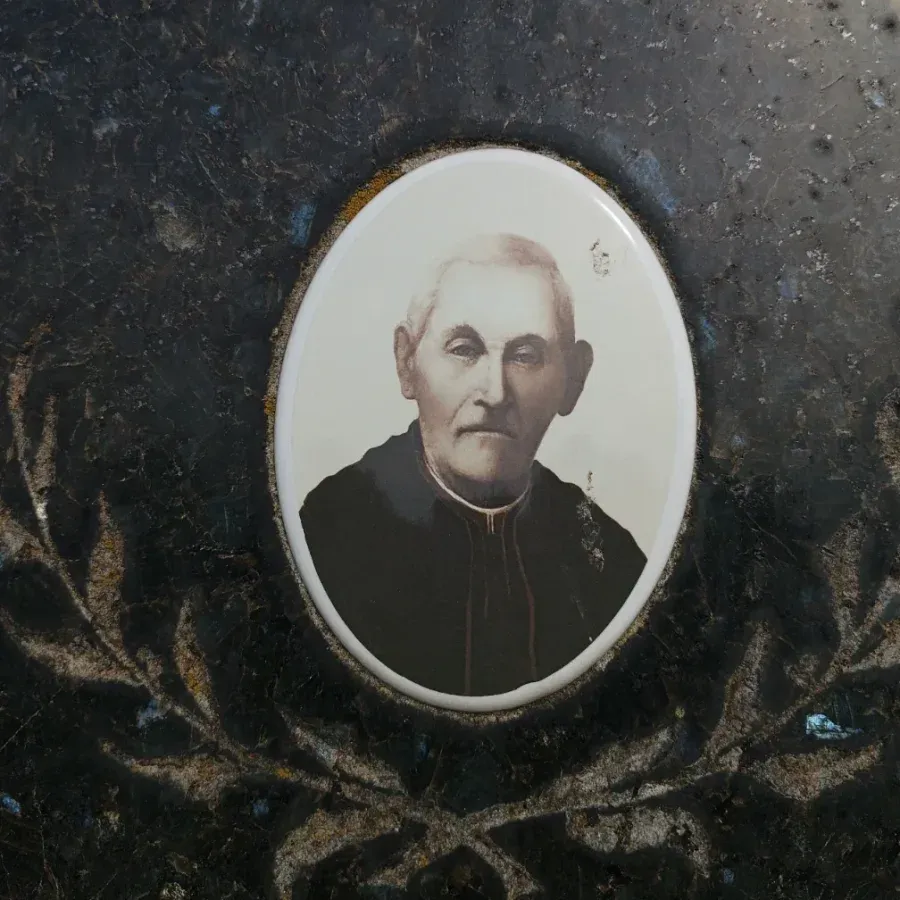
Ioan Bryttan (died 1907), Old Cemetery, Yavoriv, Lviv region.
A chapel in Hammersmith
The last stone on our list is a building. At Margravine Cemetery in Hammersmith, opened in 1868, Frederic Harold Young lies in a Gothic chapel of red sandstone, with a steep slate roof, pointed arches and a row of carved columns. He died in April 1883 at 18.

Frederic Harold Young (1865-1883), Margravine Cemetery, Hammersmith, London.
Find your own
Every photo here links to a grave page, and every cemetery we mention has its own page with a map. Thousands more carved and cast memorials wait in the archive, in the churchyards of the United Kingdom, the village cemeteries of Ukraine and Czechia, and the city cemeteries of Germany and Austria. If you know a stone that belongs on a list like this, add its photo to EveryStone and we may feature it next time.