
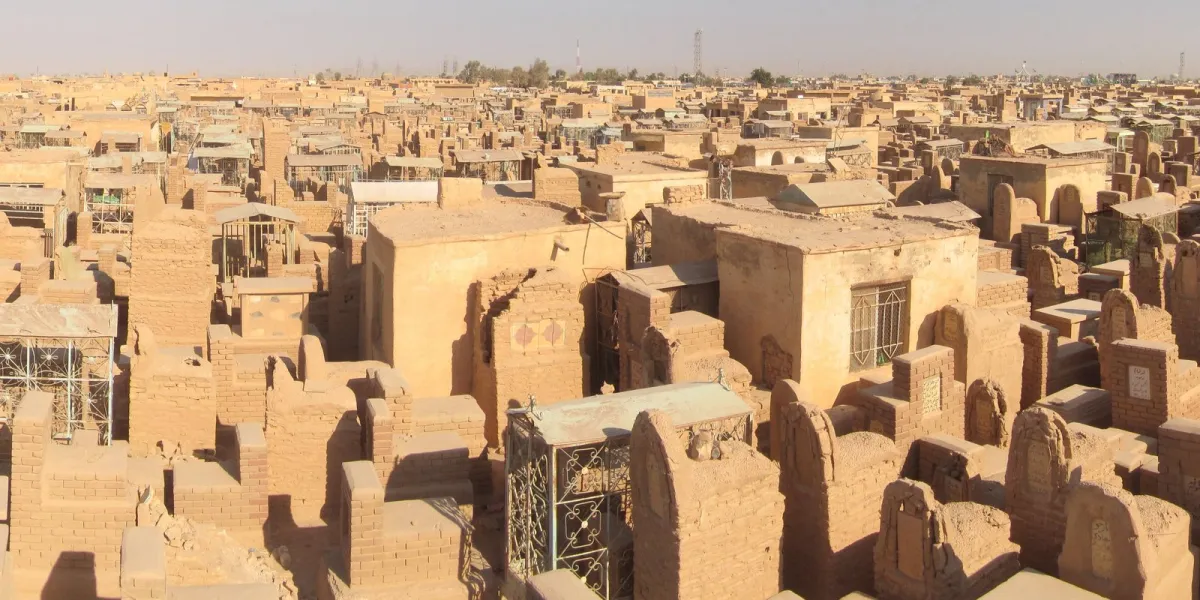
You can measure a cemetery's size by the land it covers or by the number of people buried in it, and you get different lists depending on which you pick. Some cemeteries spread across several square kilometres of roads, woodland and plots kept for future burials. Others hold millions of people on far less ground after centuries of use.
Wadi al-Salam in Iraq ranks near the top on both measures. Calvary Cemetery in New York reports almost three million interments on about 1.48 km², while Rose Hills in California covers about 5.67 km².
The tables compare published figures. Sources count over different periods and boundaries, and several contenders have no confirmed totals.
Burials, graves and land
The people-buried table counts the interments each cemetery reports over its whole history. A headstone count would come out far lower, because families share graves and cemeteries reuse plots or move remains elsewhere. Vienna Central Cemetery's operator reports about 330,000 grave sites and three million deceased, and Hamburg's Ohlsdorf about 235,000 grave sites and 1.4 million interments since it opened.
The area table uses each cemetery's published footprint. If a source includes land not yet used for burials, the table says so. It also marks the one historic necropolis on the list.
We checked these figures in 2026. Most are rounded, so cemeteries with similar totals share a position in the burial table.
Ten of the largest cemeteries by people buried
| Position | Cemetery | Location | Reported people buried |
|---|---|---|---|
| 1 | Wadi al-Salam | Najaf, Iraq | About 5–6 million; estimates vary |
| 2 | La Almudena cemetery complex | Madrid, Spain | About 5 million |
| 3–5 | Vienna Central Cemetery | Vienna, Austria | About 3 million |
| 3–5 | New Public Cemetery (Új Köztemető) | Budapest, Hungary | About 3 million |
| 3–5 | Calvary Cemetery | Queens, New York City, USA | Almost 3 million |
| 6–7 | Behesht-e Zahra | Tehran, Iran | More than 2 million |
| 6–7 | Cementerio General | Santiago, Chile | More than 2 million |
| 8–9 | Vila Formosa Cemetery | São Paulo, Brazil | More than 1.5 million |
| 8–9 | Glasnevin Cemetery | Dublin, Ireland | About 1.5 million |
| 10 | Ohlsdorf Cemetery | Hamburg, Germany | About 1.4 million |
Three cemeteries with unconfirmed totals, in Caracas, Genoa and Naples, could change this list.
1. Wadi al-Salam, Iraq
Most published estimates put its dead at five to six million, and NDTV reported more than six million bodies in 2023. Some articles repeat a figure of ten million, which no published count supports.
Many summaries give its area as about 6 km², but Iraq's 2011 submission to UNESCO's Tentative List gives 917 hectares (9.17 km²). The same document describes family burial rooms and underground vaults, which a count of visible monuments would miss, and burials going back more than 1,400 years.
2. La Almudena, Spain
Telemadrid, Madrid's regional public broadcaster, reports more than five million deceased at La Almudena, counted over the cemetery's history.
Madrid's tourism authority describes a complex of three cemeteries: La Almudena, the Civil Cemetery and the Hebrew Cemetery. A figure for the whole complex covers all three.
3. Vienna Central Cemetery, Austria
Friedhöfe Wien's 2024 anniversary account gives the Zentralfriedhof's area as almost 2.5 km², alongside the grave and burial totals above. The operator lists Beethoven, Schubert, Falco and Udo Jürgens among the people buried or remembered there.
4. New Public Cemetery, Hungary
Few English-language countdowns include Budapest's Új Köztemető, the New Public Cemetery. Its municipal operator says about three million deceased lie there, which puts it level with Vienna and Calvary.
5. Calvary Cemetery, United States
Calvary & Allied Cemeteries reported in July 2026 that Calvary in Queens holds almost three million interments on 365 acres (about 1.48 km²). The total covers Calvary's four divisions, without the organization's other cemeteries.
The operator traces its history to New York's Catholic and immigrant families, Irish, Italian and German among them, starting with the first burial in 1848. Calvary covers less ground than any cemetery in the area table, yet shares third place by burials.
6. Behesht-e Zahra, Iran
Behesht-e Zahra's director put the total above two million burials in February 2024; older figures online run lower.
Radio Zamaneh gives the cemetery's area as 584 hectares (5.84 km²), or 750 hectares with the adjoining Khomeini shrine complex. The area table uses the cemetery-only figure, to match the cemetery-only burial total.
7. Cementerio General, Chile
Santiago's Cementerio General announced in May 2026 that more than two million people lie there. Behesht-e Zahra also gives a "more than two million" figure, so the two share sixth place.
8. Vila Formosa Cemetery, Brazil
Consolare, which runs Vila Formosa in São Paulo, estimates more than 1.5 million burials since the cemetery opened in 1949, 77 years ago.
9. Glasnevin Cemetery, Ireland
Dublin Cemeteries Trust describes Glasnevin as the resting place of almost 1.5 million people. Dublin is far smaller than São Paulo, but Glasnevin holds about as many people as Vila Formosa. One operator says "almost" and the other "more than", and neither gives an exact count, so the two share eighth place.
10. Ohlsdorf Cemetery, Germany
Ohlsdorf appears in both tables. Hamburger Friedhöfe reports 389 hectares (3.89 km²) and 1.4 million interments since 1877, along with the 235,000 grave sites mentioned above. The operator calls it the world's largest park cemetery, and its grounds hold roads, ponds and woodland alongside the graves.
Ten of the largest cemeteries by area
Rank by land and you get seven new names. The order follows each site's published footprint, and the notes tell you which site is a necropolis and which include land kept for future burials.
| Cemetery or necropolis | Location | Reported area | Notes |
|---|---|---|---|
| Makli Necropolis | Thatta, Pakistan | About 10 km² | Historic necropolis, area from UNESCO |
| Wadi al-Salam | Najaf, Iraq | 9.17 km² | From Iraq's 2011 UNESCO Tentative List submission |
| Behesht-e Zahra | Tehran, Iran | 5.84 km² | Cemetery alone, without the adjoining shrine complex |
| Rose Hills Memorial Park | Whittier, California, USA | About 5.67 km² | Operator reports a 1,400-acre property |
| Calverton National Cemetery | Long Island, New York, USA | About 4.23 km² | US Department of Veterans Affairs reports 1,045 acres |
| Southern Cemetery | St Petersburg, Russia | About 4 km² | Local funeral services give about 400 hectares |
| Northern Cemetery | Rostov-on-Don, Russia | About 4 km² | Local press gives about 400 hectares |
| Abraham Lincoln National Cemetery | Elwood, Illinois, USA | About 3.97 km² | VA reports 982 acres, including land for future burials |
| Ohlsdorf Cemetery | Hamburg, Germany | 3.89 km² | Operator reports 389 hectares |
| Spring Grove Cemetery and Arboretum | Cincinnati, Ohio, USA | About 2.97–3.04 km² | Operator pages give 733 and 750 acres; about 450 acres developed |
The two Russian cemeteries report round figures, so they could swap places with Calverton or Abraham Lincoln.
Makli, a historic necropolis
UNESCO describes Makli as about 10 km² holding around half a million tombs and graves, with monuments to rulers, religious figures and scholars of Sindh from the fourteenth to the eighteenth century. It tops the area table as an archaeological site; to compare working cemeteries, start the list at Wadi al-Salam. UNESCO counts tombs and graves, so Makli stays out of the burial table.
Land kept for future burials
Rose Hills calls itself North America's largest cemetery, on a 1,400-acre property, and the VA lists Calverton at 1,045 acres. Lists built around famous names such as Arlington or Brookwood leave both out.
The VA says Abraham Lincoln National Cemetery's 982 acres will provide 400,000 burial spaces once developed.
Spring Grove's own pages disagree on its size: the history page gives 733 acres and the general information page 750. Both put the developed area at about 450 acres, so the table shows the range.
Three cemeteries with unconfirmed totals
If an operator or registry confirms the higher totals below, all three cemeteries would enter the burial table.
Cementerio General del Sur, Caracas, Venezuela
A journalist's estimate in 70 años de crónicas en Venezuela puts three million deceased in Caracas's Cementerio General del Sur, level with Vienna, Budapest and Calvary. We found no operator total or burial register to confirm it, and the account doesn't say what it counted.
Staglieno, Genoa, Italy
Nikon School, in a photographic feature, gives Staglieno more than two million burials, which would put it beside Santiago and Behesht-e Zahra. We found no operator or municipal record to confirm it. A dated record from the city or the cemetery that accounts for exhumations would settle it.
Cimitero delle 366 Fosse, Naples, Italy
The Cimitero delle 366 Fosse in Naples used 366 numbered communal pits, one for each day of the year, in a yearly cycle.
TGFuneral24, a funeral-industry publication, reports estimates from more than 700,000 bodies to about 2.5 million, and says incomplete records rule out a definitive total. At 2.5 million the cemetery would rank around sixth; at 700,000 it would fall outside the table.
Reading the two tables
A firmer ranking of the large cemeteries would need operators to count burials and land the same way and date their figures to the same year. On the figures published by October 2026, Wadi al-Salam leads by people buried, and Makli leads by area once you count historic necropolises.