
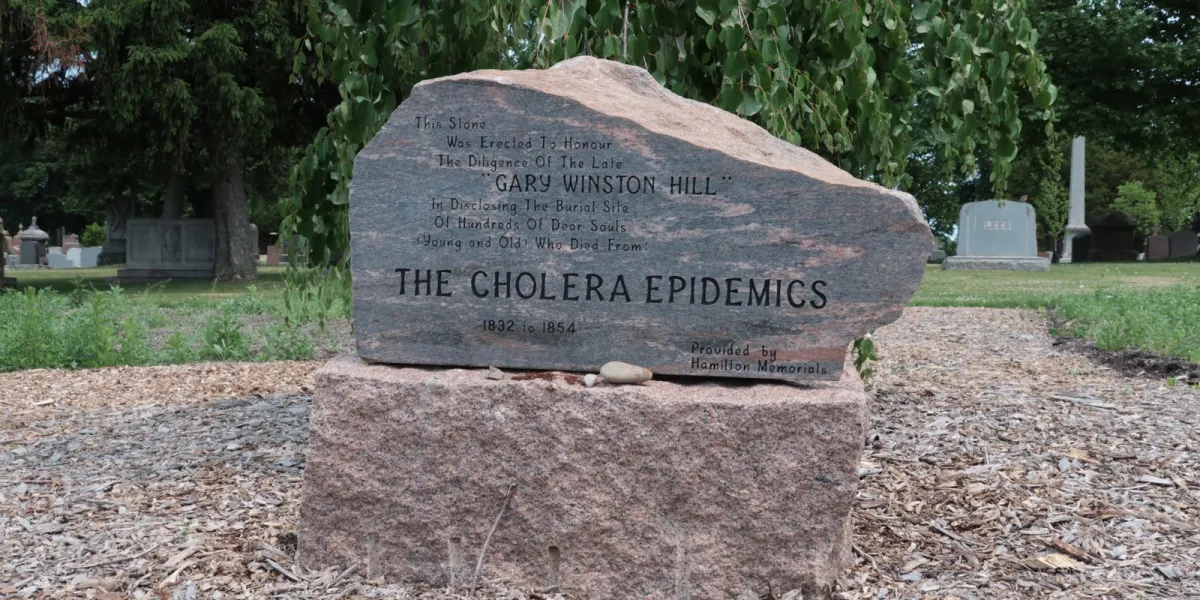
For most of European history the dead lay in the middle of town, in the churchyard around the parish church or in vaults under its floor. By 1900 most cities buried their dead in large cemeteries on the edge of town, run by a council or a burial board. Governments and town councils made that change as industrial cities grew, and they gave hygiene as the reason. Epidemics hurried them: plague, and then cholera, filled churchyards in weeks and left councils looking for new ground fast.
Plague cemeteries came first
Towns had moved burials out before. When plague struck, a churchyard inside the walls could not take the dead, and councils opened emergency ground outside. Munich laid out the Alter Südfriedhof in 1563 as a plague cemetery beyond the city walls, in front of the Sendlinger Tor. It grew into the city's central cemetery.
Some plague graves were never part of a cemetery at all. In the Derbyshire village of Eyam, which shut itself off during the plague of 1665 and 1666, families buried their own dead in the fields. The Riley Graves are an egg-shaped enclosure with a drystone wall around seven graves of the Hancock and Talbot families. Historic England lists the enclosure at Grade II and records burial dates in early August 1666.
Laws that moved burial outside towns
In the late 18th century governments began to ban burial in town centres as a matter of policy. Officials gave hygiene as the reason, in particular the risk to groundwater from churchyards that had been reused for centuries.
In Austria, Emperor Joseph II issued a decree in 1784 that forbade further burials in the cemeteries inside Vienna's outer walls. New cemeteries opened beyond them, among them St. Marx, where Mozart was buried in 1791. The rule spread across the Habsburg lands, and you can still see it in Czech, Slovak, Polish and Hungarian towns that keep an old churchyard in the centre and a newer cemetery on the road out.
France followed with the imperial decree of 12 June 1804, often called the Edict of Saint-Cloud. It banned burial in churches, temples, synagogues and hospitals and placed new cemeteries at least 35 to 40 metres beyond the town boundary. Paris opened Père Lachaise the same year, though, as the Fondation Napoléon notes, many Parisians at first refused to be buried on a hill outside the city. French rule carried the decree into Italy in 1806.
Scandinavia moved at the same time. Oslo, then Christiania, consecrated Vår Frelsers Cemetery on 17 June 1808, in the famine and epidemic years of the Napoleonic Wars. From 1811 to 1833 it was the city's only burial ground, according to the Store norske leksikon. Henrik Ibsen, Edvard Munch and Bjørnstjerne Bjørnson now lie in its Grove of Honour, laid out in 1904.
Cholera reaches Europe, 1831
Cholera spread out of India in the 1820s. It reached Orenburg on the southern Urals in August 1829, and Russian soldiers carried it into Poland in February 1831. In Warsaw that summer 2,524 people died. Doctors did not yet know the disease travelled in dirty water. Fearing contagion, towns buried the victims in ground set apart from everyone else.
Some towns found that ground within weeks. In Opole, in Prussian Silesia, the town opened the cholera cemetery in 1831 as an auxiliary burial ground. Only 83 people were buried there, among them the brewery owner Wilhelm Thau, the district judicial counsellor Franz Adamczyk and the wife of the town physician, Dr. Zedler.
The disease reached Britain in October 1831, on a ship from the Baltic that docked at Sunderland. Newcastle University's cholera archive dates the first death in the town to 23 October 1831. From there it moved north into Scotland and south towards London, where 6,536 people died.
In Dublin, Bully's Acre in Kilmainham, often called the city's oldest cemetery, had taken burials for more than a thousand years. Nearly 6,000 people were buried there in that year's cholera epidemic, and it closed afterwards. In Rotterdam the city could not wait for its new cemetery to be finished: Crooswijk General Cemetery went into use in July 1832 because cholera had left too many dead to bury. It is now a national monument.
A wave of new municipal cemeteries
After the first pandemic, councils built the permanent cemeteries that the earlier laws had called for. Lisbon created two municipal cemeteries in the summer of 1833 after cholera made burial inside the city impossible. The western one, now Prazeres Cemetery, is one of the largest in the city.
Some towns acted before the disease arrived. Stavanger bought land for Lagård Cemetery in 1832, amid fears of a cholera epidemic, and consecrated it in 1834, when the old churchyard closed. It still lies next to the railway station, split in two by Kirkegårdsveien, and covers about 45,000 square metres.
In Naples, when cholera struck the city and the towns around Vesuvius in 1836, the neighbouring municipalities of San Giovanni a Teduccio, Barra, San Giorgio a Cremano, Portici and Ercolano built a shared cemetery for the victims. The Naples Cholera Cemetery at Barra holds only people who died of cholera in the 19th-century epidemics. The physicist Macedonio Melloni, who died in the outbreak of 1854, was buried there.
The second wave and the Burial Acts
Cholera returned in 1848. In England and Wales the two-year outbreak of 1848 and 1849 killed about 52,000 people, and a further outbreak in 1854 killed about 23,000 in Great Britain, according to figures in the history of the 1846-1860 pandemic. That year the doctor John Snow traced 616 deaths in Soho to one water pump on Broad Street.
Campaigners against burial in towns had argued for years that London's churchyards were dangerous, and after 1848 Parliament acted. The Burial Act 1852 let the government close churchyards in the capital and set up burial boards, paid from the rates, to open new cemeteries. An act of 1853 extended the system beyond London, and further acts followed in 1855 and 1857. Across England and Wales, parishes and towns formed burial boards and bought land on their edges.
Sunderland, where British cholera had begun, was one of them. Bishopwearmouth Cemetery was created after the 1831 epidemic left the churchyards overcrowded. The parish sold 34 acres of its glebe land for £275 an acre, and the cemetery opened in 1856. By 2010 it covered 80 acres. Child victims of the Victoria Hall disaster of 1883 are buried there, and its central chapel is listed at Grade II.
In Salford, Weaste Cemetery opened in 1857 as Salford Borough Cemetery. It covers about 39 acres, once had four chapels, and has seen more than 332,000 burials.
On the continent, after cholera struck Žatec in Bohemia in 1850, the town bought land across the Ohře bridge for 600 gulden, consecrated the new Žatec Cemetery that year and closed the old burial ground at the church of St Wenceslas. A Neo-Renaissance gate and the Church of St Anthony of 1873 now mark it. In Drammen, Norway, the town laid out Bragernes Lower Churchyard in 1853 as a cholera cemetery, because the disease was expected to claim many lives.
Later outbreaks and small walled plots
Cholera kept returning for the rest of the century, and many of the burial grounds it left are small. In 1866 armies spread it: during the Austro-Prussian War the disease broke out in the Prussian army and passed to the parts of Lower Austria the troops occupied. At the Maria Dreieichen Cholera Cemetery the first person buried was a Prussian soldier, Gustav Maverspörg, on 4 August 1866. The site is now a protected monument.
In Warsaw the epidemic of 1872 and 1873 led to the Praga Północ Cholera Cemetery, opened on 16 November 1872 on the esplanade of the Śliwicki fort to a design by the engineer Henryk Suminski. About 484 cholera victims and seven soldiers lie there, between railway embankments. A local factory owner, Cezary Skoryna, looked after it.
What survives today
Cholera and plague burial grounds survive in four forms:
- Large municipal cemeteries. Many of the cemeteries opened in a hurry became the main cemetery of their town, like Crooswijk, Lagård or Žatec. The epidemic origin is often recorded only in local histories.
- Small walled plots. Single-purpose cholera cemeteries, like those at Opole or Maria Dreieichen, served one outbreak, or a few. They survive as small fenced or walled plots, and Opole's took only 83 burials.
- Sections inside older cemeteries. Some parish and Jewish cemeteries set aside a separate cholera section or common grave for the victims.
- Neglected sites. In November 2025, on the Day of the Dead, local residents in Naples held a Mass outside the closed gates of the Barra cemetery because its condition made entry impossible, as Pressenza reported.
Many of the people buried in these places have no headstone; parish registers and town records hold their names, where any survive.
Find epidemic cemeteries in the archive
You can find each of these cemeteries in the EveryStone archive, with its location, outline and any graves recorded so far. Many more cholera and plague burial grounds are listed among the cemeteries of Poland, Czechia, Germany, Norway, Italy and the United Kingdom. If you know of a cholera plot near you, you can add photos and records of the people buried there.