
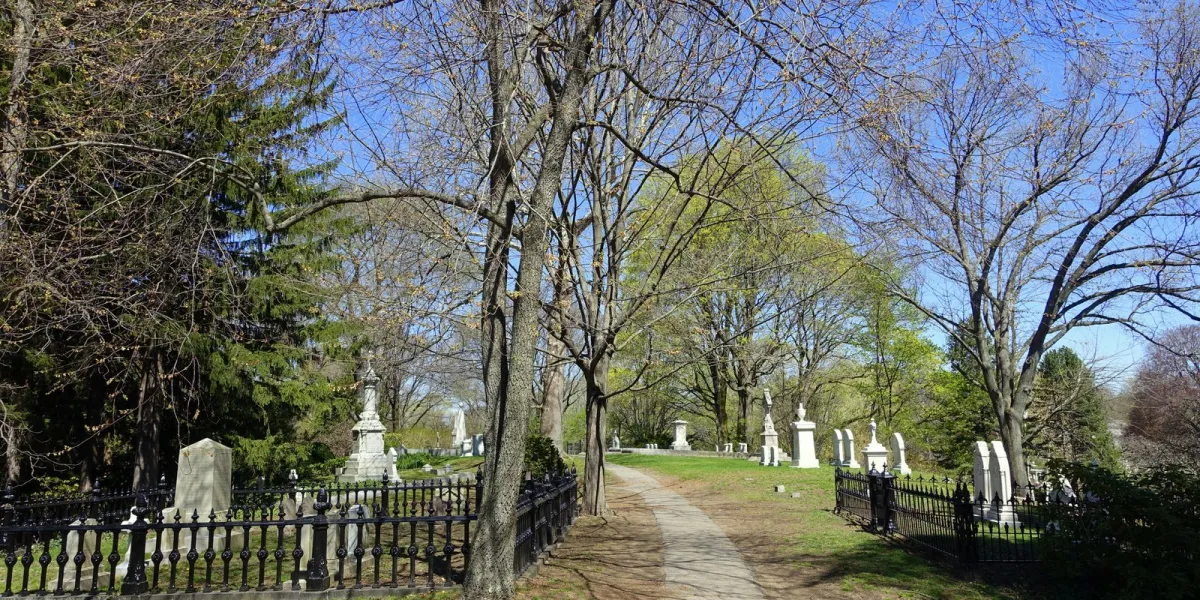
For centuries most towns buried their dead in crowded churchyards in the middle of the town. In the early 19th century, city authorities and private companies began to move burials out to open land on the edge of town, and they planted that land like an estate garden, with winding paths, specimen trees and views over water. Many of these places are now the largest green spaces in their cities, and some are run as arboretums or nature reserves.
Sixteen of them are in the EveryStone archive.
Père Lachaise and the garden cemetery
Père Lachaise opened in 1804 on the slopes of Mont-Louis, east of central Paris. The architect Alexandre-Théodore Brongniart drew on English landscape gardens for its plan, with curving paths and planted terraces instead of rows of graves. In 1817, to raise its profile, the administrators moved the remains of La Fontaine and Molière there. The cemetery grew from about 17 hectares to 44, and the city of Paris now describes it as the largest green space inside the city limits, with about 3 million visitors a year. The cemetery has stopped using pesticides, and foxes now raise their cubs among the tombs.
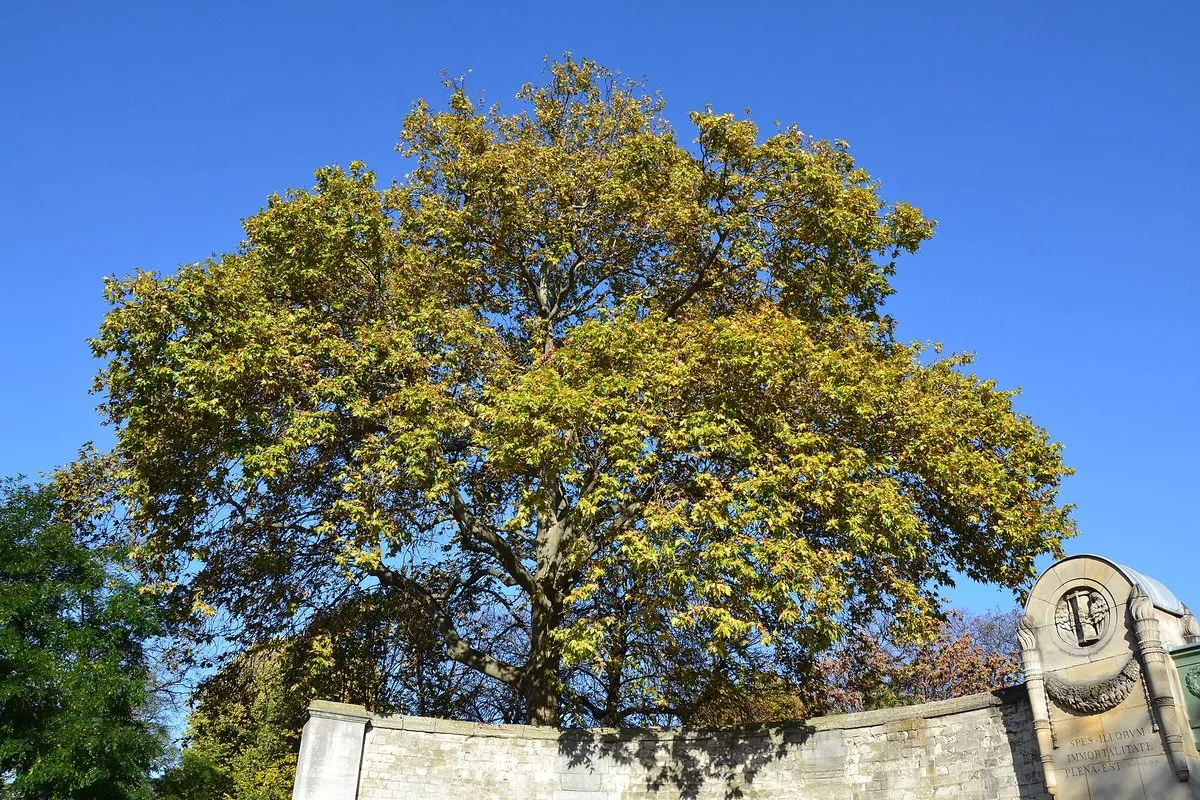
Autumn in Père Lachaise, Paris. Photo: Jeanne Menjoulet, CC BY 2.0, via Wikimedia Commons.
Mount Auburn and the rural cemetery movement
Americans took up the idea within a generation. In 1825 the Boston physician Jacob Bigelow proposed a cemetery outside the city, and in 1831 the Massachusetts Horticultural Society used 72 acres in Cambridge to create Mount Auburn, the first rural cemetery in the United States. Soon after it opened it was as popular with tourists as Niagara Falls and Mount Vernon. According to the American Planning Association, nine major cemeteries were modelled on it within fifteen years, and it helped inspire New York's Central Park. Today it covers about 175 acres and holds roughly 5,000 trees of almost 700 species, some of its oaks older than the cemetery itself. Massachusetts Audubon has named it an Important Bird Area, and birdwatchers arrive by the thousands for the spring migration.
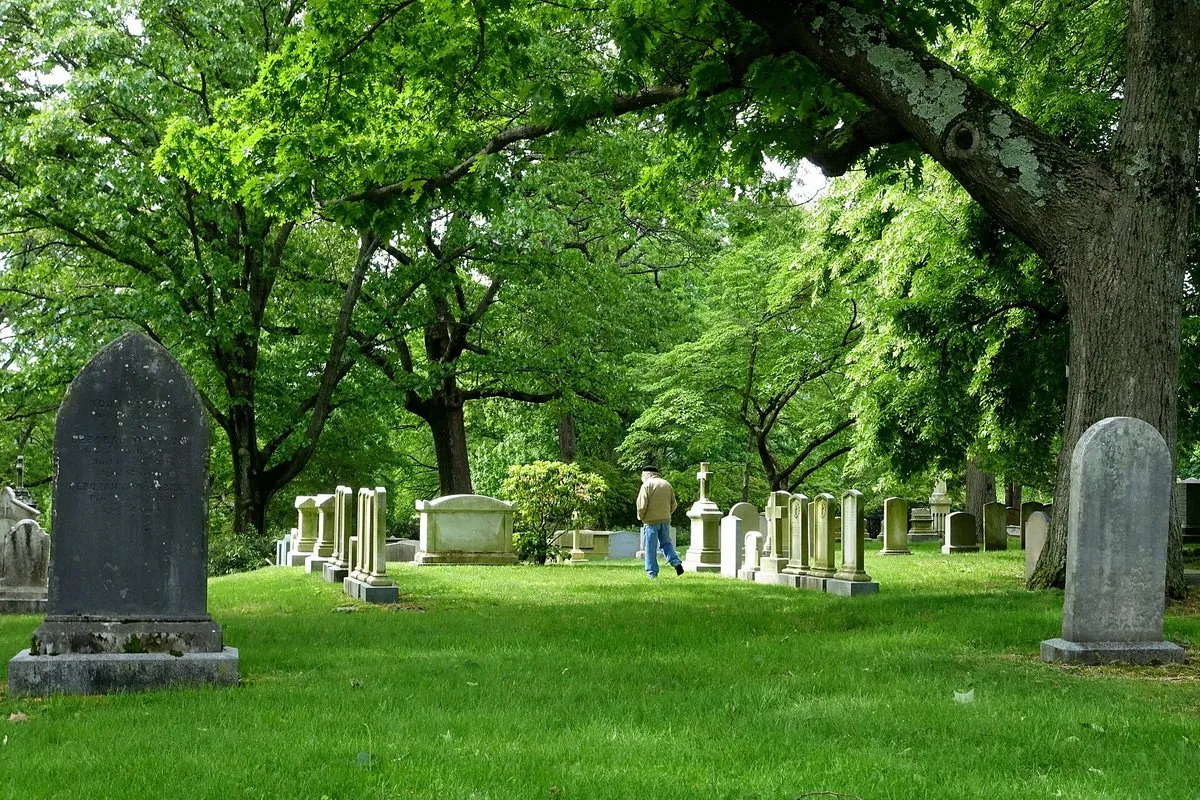
Mount Auburn Cemetery, Cambridge, Massachusetts. Photo: Daderot, public domain, via Wikimedia Commons.
Green-Wood Cemetery in Brooklyn followed in 1838. Its 478 acres hold about 600,000 graves and about 7,000 trees of more than 700 species. In 2015 it gained Level III accreditation as an arboretum, and by 2019 it was one of only 29 such arboretums in the world. That year National Geographic reported that entomologists had found a jewel beetle new to science in its old European beeches. A relic population of redback salamanders lives in a hidden glen.
Cemeteries that are arboretums
The rural cemetery movement spread across the United States, and several of its cemeteries now manage their trees as a formal collection.
- Graceland Cemetery, Chicago: a park-like garden cemetery on the North Side and a certified arboretum. Many of the city's best-known architects are buried there, among them Ludwig Mies van der Rohe.
- Bonaventure Cemetery, Savannah: set on a bluff of the Wilmington River among live oaks hung with Spanish moss. The City of Savannah bought it in 1907, and the novel and film Midnight in the Garden of Good and Evil made its Victorian sculpture famous.
In London, Abney Park in Stoke Newington opened in 1840 as one of the "Magnificent Seven" commercial cemeteries. Hackney's Loddiges nursery planted it as an arboretum of exotic trees, and accounts put the original collection at about 2,500 trees and shrubs, beside a rose garden of more than 1,000 varieties. About 200,000 people lie in some 60,000 graves. Hackney Council declared the 12.5 hectares a local nature reserve in 1993, and it is now one of London's most central woodlands.
Avenues of yew, lime and beech
In 19th-century Europe, cemetery planners often used trees as architecture and planted formal avenues leading to a chapel or gate.
The Westerbegraafplaats at Ghent West Cemetery covers 23 hectares, almost half of it green. The city laid it out as a park in the English landscape style, and an avenue of beeches leads to the portal built between 1867 and 1882. Jews, Protestants and liberal citizens of Ghent were buried here alongside the city's wealthy families.
The Old Cemetery in Greifswald dates from the period when decrees by the Swedish king Gustav III in 1778 and the French occupation in 1808 banned burials inside churches and town walls in Swedish Pomerania. A yew avenue about 90 years old leads to the centre of the grounds, where the chapel once stood.
Weimar's Historic Cemetery opened in 1818 on a rise in the south-west of the city, next to the Poseck Garden. It is a park of old trees around the Weimar Princes' Vault and forms part of the UNESCO World Heritage site Classical Weimar.
In Lausanne, the Bois-de-Vaux Cemetery, designed by the architect Alphonse Laverrière, has a long central avenue lined with a double row of lindens, flower beds and ponds with water lilies.
The woodland cemetery
German planners went further at the start of the 20th century and put the graves into an existing forest. Munich's Waldfriedhof, laid out by the city architect Hans Grässel and opened in 1907, was the first cemetery of this kind in Germany. Grässel kept the buildings low and the paths narrow so the trees would dominate, and grouped the graves in groves. The city of Munich says the design was seen as a model for cemeteries across Germany and Europe. The old and new parts together hold about 64,500 graves. Many German towns later built a Waldfriedhof of their own.
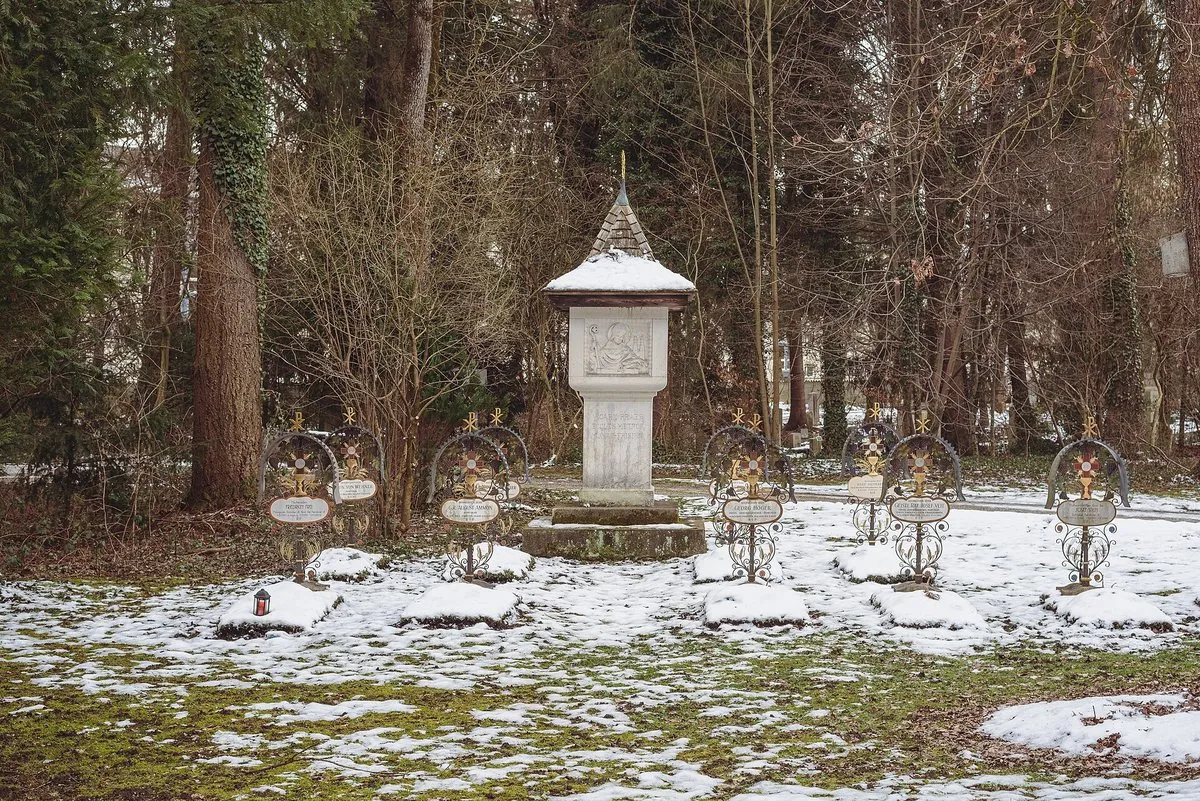
Graves among the trees of Munich's Waldfriedhof in winter. Photo: Flocci Nivis, CC BY 4.0, via Wikimedia Commons.
Ohlsdorf Cemetery in Hamburg opened in 1877 as a non-denominational burial ground outside the city and grew to close to 400 hectares. The Hamburg cemeteries authority describes it as the largest park cemetery in the world. Hamburg's tourist board counts about 25,000 trees of 450 species, a great many rhododendrons, and ponds where kingfishers, tawny owls and long-eared owls breed.
In Stockholm, the city held an architectural competition in 1914 and 1915 for a new cemetery south of the centre. Two young architects, Gunnar Asplund and Sigurd Lewerentz, won with an entry called "Tallum". Skogskyrkogården, the Woodland Cemetery, was laid out from 1917 on former gravel pits overgrown with pine, and Asplund's small Woodland Chapel opened in 1920. The brief asked for dignified surroundings without large monuments, and the graves sit among the pines. UNESCO inscribed it as a World Heritage Site in 1994 and notes its influence on cemetery design in many countries. Greta Garbo has been buried there since 1999.
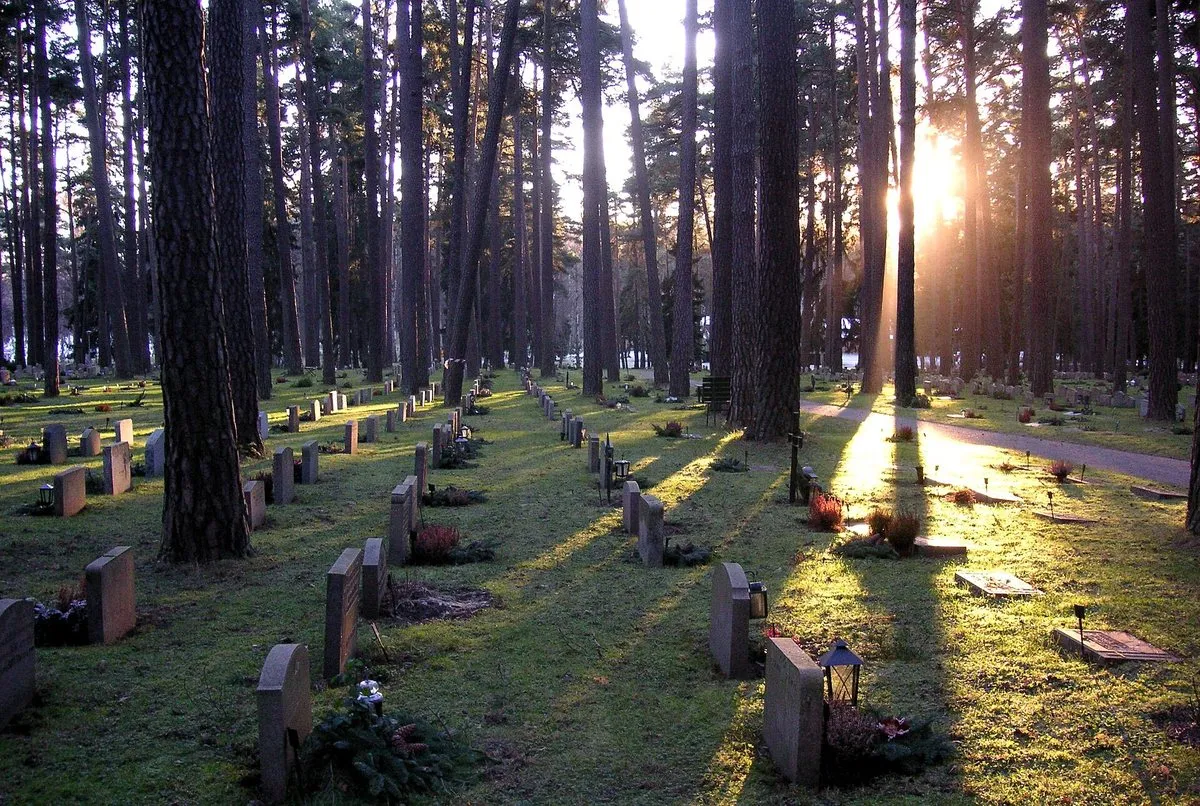
Graves in the pine forest of Skogskyrkogården, Stockholm. Photo: Holger Ellgaard, CC BY-SA 3.0, via Wikimedia Commons.
What trees cemeteries plant, and why
- Yew: the Woodland Trust counts at least 500 churchyards in England with yews older than the church. The tree stood for immortality and for doom, and its leaves, bark and seeds are poisonous. One explanation for churchyard yews is that they kept villagers from grazing cattle on church ground. Another holds that yews were planted on the graves of plague victims.
- Cypress: the Mediterranean cypress has been linked with death since antiquity. In Ovid's story the grieving youth Cyparissus turned into one, and Athenian households in mourning hung its boughs. It remains the main cemetery tree across southern Europe and the Muslim world.
- Weeping willow: mourners in many countries link it with grief, and its image is often carved on headstones. A willow beside Napoleon's grave on St Helena became famous, and nurserymen later sold weeping willows as the "Napoleon willow".
- Lime (linden): the tree of many cemetery avenues, from Lausanne to Amiens. The cemetery of Longprès in Amiens was planted with lime trees from the start and gained Lawson cypresses along its main avenue in the 1970s.
- Oak: often older than the cemetery itself, as at Mount Auburn, or the defining tree of the place, as with the live oaks of Bonaventure.
The oldest cemetery tree may be the Fortingall Yew in Fortingall Parish Churchyard, Perthshire, on an early Christian site, behind a low wall built in 1785 to protect it. Estimates of its age run from about 1,500 years to Forestry and Land Scotland's figure of around 5,000, which would make it one of the oldest trees in Europe. Visitors once cut off pieces as souvenirs. The tree is male, but in 2015 botanists reported that one small branch had started to bear berries.
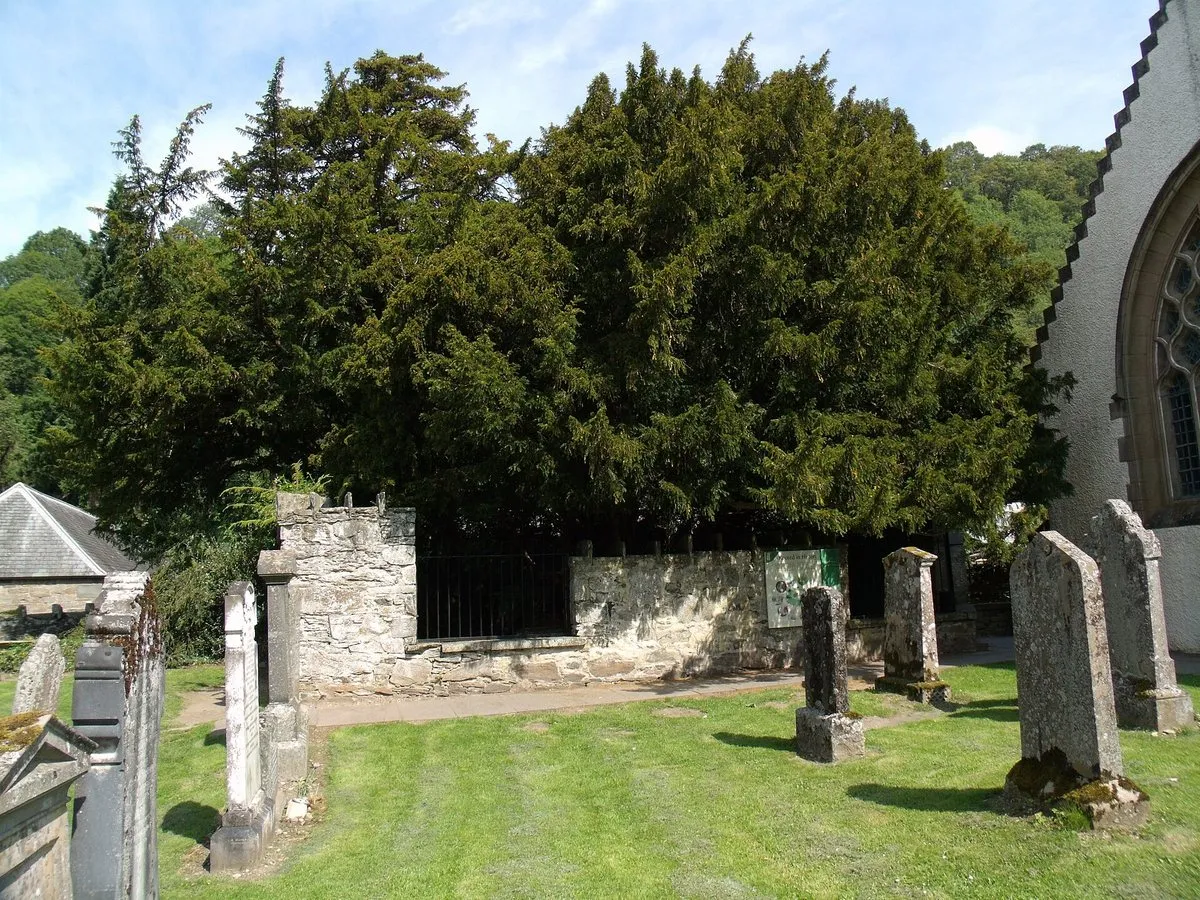
The Fortingall Yew in Fortingall Parish Churchyard, Perthshire. Photo: Euan Nelson, CC BY-SA 2.0, via Wikimedia Commons.
Old cemeteries as nature reserves
As Victorian cemeteries filled and fell out of use, their owners let some grow wild. Tower Hamlets Cemetery Park in east London opened in 1841, another of the Magnificent Seven, and holds more than 350,000 burials. It is now a deconsecrated cemetery, a public park and a Local Nature Reserve, looked after by a Friends group since 1990. Abney Park went the same way. Smaller grounds followed: Holywell Cemetery in Oxford, where Kenneth Grahame is buried, is now also a wildlife refuge, and the Friends of Ryde Cemetery on the Isle of Wight have made about 1.5 acres of its oldest part a nature reserve.
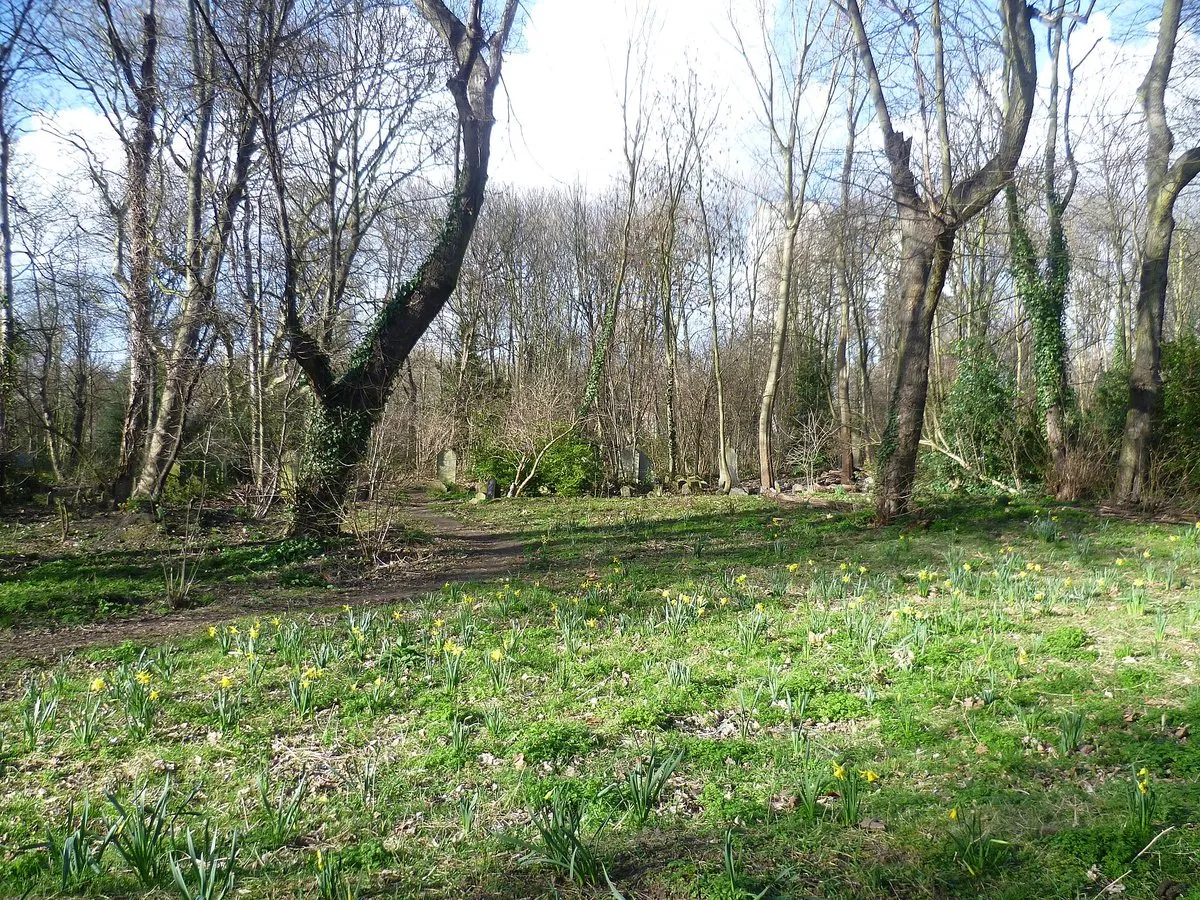
A glade in Tower Hamlets Cemetery Park, London. Photo: Marathon, CC BY-SA 2.0, via Wikimedia Commons.
Visiting a garden cemetery
- Check opening hours: many garden cemeteries close at dusk, and some lock their gates earlier in winter.
- Look for tree tours: Green-Wood has run walks on its great trees, and many Friends groups lead tours on birds, plants or garden history.
- Stay on the paths: at Abney Park, Tower Hamlets and the other reserves, the undergrowth between the graves is habitat, and old stones can be unstable.
You can find each of these cemeteries in the EveryStone archive, along with thousands of others in Germany, the United Kingdom, France, Sweden and the United States.