
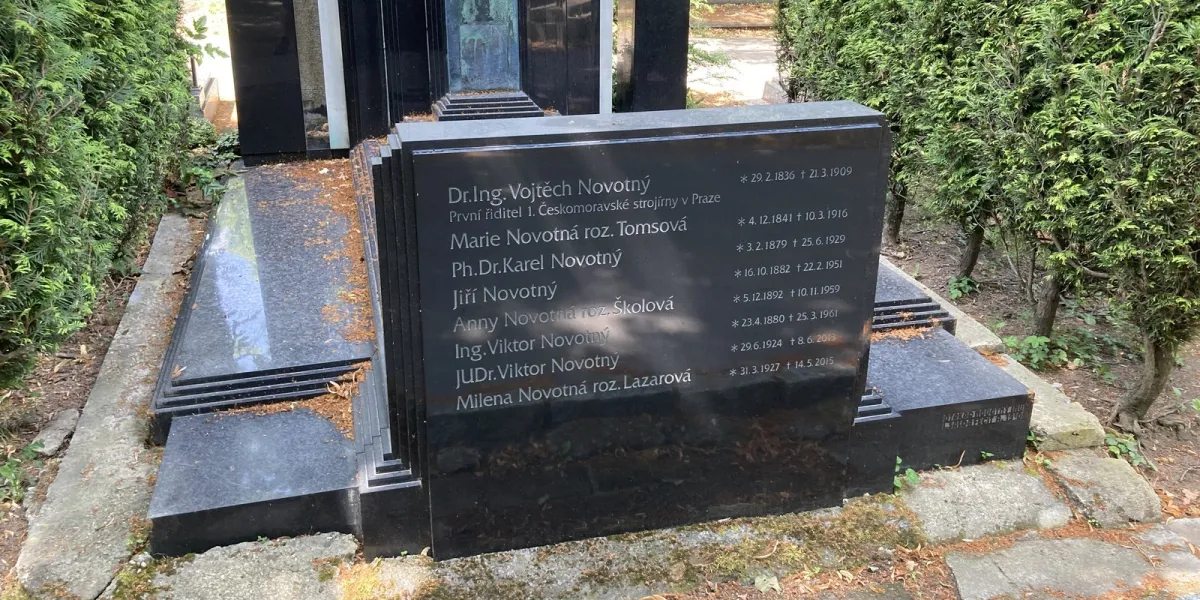
A surname on a headstone often records what a family did six or seven hundred years ago. Smiths, millers, tailors and coopers fill the cemeteries of Europe, each in their own language, alongside newcomers, sons of Peter and a few old nicknames that stuck.
We counted the surnames on every public grave record in the EveryStone archive for the thirteen countries where we hold more than 10,000 graves, about 545,500 records in all.
How we counted
Many European surnames change with the person they belong to. A Czech Novák's wife is Nováková, a Polish Kowalski's wife is Kowalska, and in Lithuania Petrauskas becomes Petrauskienė for a married woman and Petrauskaitė for an unmarried one. We grouped the male and female forms of each surname into one count. We also merged spellings that differ only by a missing accent, such as Szabo and Szabó. For Ukraine we counted the Cyrillic form on the stone, so Boiko and Boyko, two Latin spellings of Бойко, count once.
These are counts of grave records, which come from volunteer photographers and partner archives that work cemetery by cemetery, and they differ from a census of the living. A single well-photographed town can lift a local name into the national top five.
The leading surnames at a glance
| Country | Five most common surnames |
|---|---|
| Slovakia | Tóth, Nagy, Szabó, Horváth, Varga |
| Czechia | Novák, Svoboda, Novotný, Procházka, Černý |
| United Kingdom | Jones, Smith, Williams, Thomas, Wilson |
| Poland | Nowak, Kaczmarek, Szymański, Jankowski, Kowalski |
| Ukraine | Bondarenko, Kovalenko, Boiko, Kulyk, Koval |
| Germany | Müller, Schmidt, Schneider, Weber, Meyer |
| Lithuania | Petrauskas, Kazlauskas, Stankevičius, Paulauskas, Adomaitis |
| Finland | Korhonen, Manninen, Karjalainen, Lehtinen, Virtanen |
| Denmark | Nielsen, Pedersen, Jensen, Sørensen, Hansen |
| Austria | Müller, Schneider, Schmid, Wagner, Huber |
| Hungary | Szabó, Tóth, Nagy, Kovács, Horváth |
| Belgium | Claes, Gérard, Wéry, Wauters, Vanderlinden |
| Sweden | Svensson, Nilsson, Persson, Andersson, Johansson |
The meanings below come from Behind the Name, an etymology database that cites its sources, unless we name another source.
Slovakia
Slovakia gives us the largest sample, and all five of its leading names are Hungarian. Two are trades: Szabó is the tailor and Varga the cobbler. Two name neighbours. Tóth comes from the Hungarian tót, which meant "Slovak" or "Slovene", and Horváth is the Hungarian and Slovak form of Horvat, "Croat". Nagy means "big".
Southern Slovakia has a large Hungarian community. Kolárovo Municipal Cemetery, in a town the Hungarians call Gúta, holds 4,057 of our Slovak graves, among them 300 of the 500 Szabós. About three quarters of Kolárovo's people gave Hungarian as their ethnicity in the 2021 census.
The first Slovak-form names come sixth and eighth: Kováč (368) and Polák (359). Kováč means "blacksmith", and its Hungarian twin Kovács adds another 209 graves. Counted together, the smiths would top the list. Polák means "a Pole". The Interior Ministry's national table, reported by Noviny.sk, ranks Horváth first, then Kováč, Varga, Tóth and Nagy.


František (Ferenc) Szabó (1927-1980), Kolárovo Municipal Cemetery, his name in Hungarian order on the stone; Eduard Horváth (1937-1994), Skalica Cemetery.
Czechia
Czechia follows its national statistics more closely than any other country here. Novák, Svoboda and Novotný hold the first three places, as they do in the Czech Interior Ministry's count of living people. Procházka and Černý follow; Dvořák, fourth nationally, comes ninth in our archive with 181 graves.
Novák comes from the Slavic novŭ, "new", a name for someone new to the village, and Novotný is a Czech variant of it. Svoboda means "freedom" and marked a freeman, someone who was not a serf. Procházka means "walk" or "stroll" and was given to travelling tradesmen. Černý means "black". Women make up nearly half of the Novák count: 227 of our 475 Nováks are Novákovás. Nearly three quarters of our Czech graves (50,892) lie in the four Moravian regions, from Zlín to Moravia-Silesia.
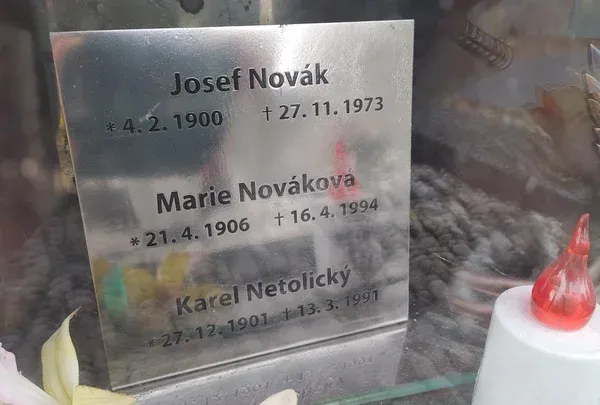
Marie Nováková (1906-1994), on a plaque she shares with Josef Novák, České Budějovice 6-Mladé Cemetery.
United Kingdom
In the United Kingdom, Jones (718) edges past Smith (703). Jones grew from Jon, a medieval form of John, and is the most common surname in Wales. Our Joneses gather in Carmarthenshire (134) and on Anglesey (66). Smith, from the Old English smiþ, a metalworker, leads in most of the English-speaking world. Williams means "son of William", and Davies, sixth with 327, is a variant of Davis, from David.
National tables give Smith, Jones, Taylor, Brown and Williams for England and Jones, Williams, Davies, Evans and Thomas for Wales, so our British sample leans Welsh.
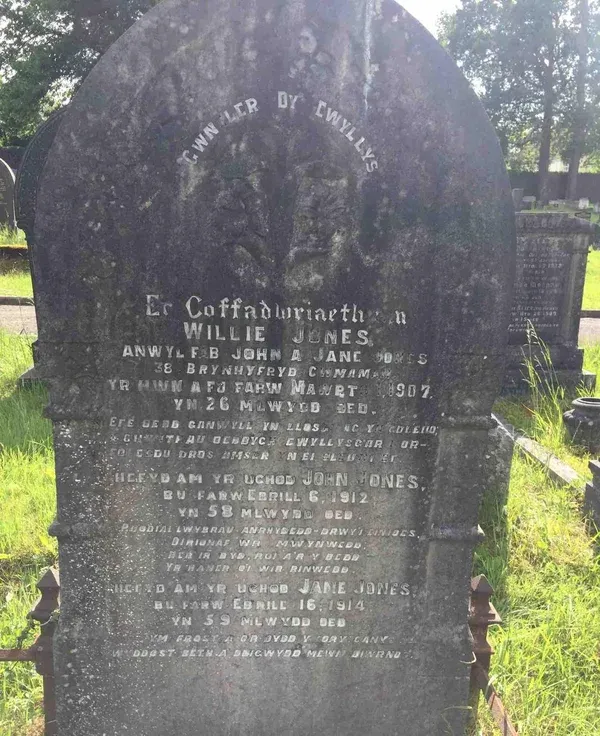
Jane Jones (1855-1914), named on a Welsh-language family stone, Aberdare Cemetery.
Poland
Poland puts Nowak first, as the national register does. The PESEL figures released by the Ministry of Digital Affairs in 2021 counted about 203,000 Nowaks, ahead of Kowalski, Wiśniewski, Wójcik and Kowalczyk. Our list continues differently: Kaczmarek, Szymański, Jankowski, then Kowalski.
Nowak is the Polish cognate of Novák, the newcomer. Kaczmarek was an innkeeper, from karczma, "inn". Szymański comes from the given name Szymon, Jankowski from a place called Jankowo or Janków, and Kowalski from kowal, "blacksmith". A third of our Polish graves (16,530) lie in Greater Poland, and the names ending in -ak that crowd the next places come mostly from there: 126 of our 136 Ratajczaks are buried in that region.
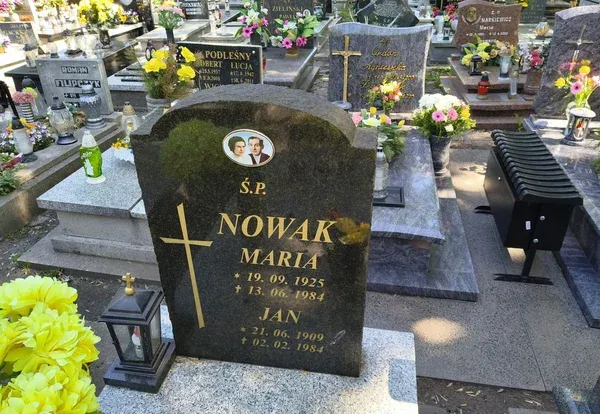
Jan Nowak (1909-1984), Holy Spirit Parish Cemetery, Świętochłowice.
Ukraine
Counted by Latin spelling, the top five for Ukraine is Bondarenko, Kovalenko, Koval, Kulyk and Kravchenko. Our Ukrainian records also keep each name in Cyrillic, and counting those changes the order: Бойко appears as Boiko 78 times and Boyko 62 times, Кулик as Kulyk 127 times and Kulik 12. Counted once each, the top five is Bondarenko (154), Kovalenko (149), Boiko (140), Kulyk (139) and Koval (127). Nehoda (124) and Melnyk (110) come next, and Kravchenko drops to eighth (104). Nearly all the Nehodas lie in one cemetery, Pohreby near Kyiv.
Bondarenko comes from bondar, "cooper", and Kovalenko from koval, "blacksmith"; the Wikipedia table of Ukrainian surnames renders them "cooper's son" and "smith's son". Koval is the smith himself. Boiko first marked a member of the Boykos, a people of western Ukraine, and Kulyk means "sandpiper". Kravchenko goes back to kravets, "tailor".
The genealogy portal Ridni.org, cited in that table, ranks Melnyk, Shevchenko, Kovalenko, Bondarenko and Ivanov first among living Ukrainians. Shevchenko appears on only 24 of our Ukrainian graves. Lviv Oblast holds 45% of our Ukrainian records, so village clusters weigh heavily: 62 of the 139 Kulyks lie in the Solonka village cemetery.


Mykyta Bondarenko (1883-1972), Pohreby Cemetery; Nikolay Boyko (1885-1972), Kurylivka Village Cemetery 2, Sumy Oblast.
Germany
Germany's leading names are medieval trades. Müller is the miller, Schmidt the smith, Schneider the tailor, from schneiden, "to cut", and Weber the weaver. Meyer comes from the Middle High German meier, a bailiff or steward, and later meant a tenant farmer. The Meier and Meyer spellings are more common in the north, and 120 of our 195 Meyers lie in Lower Saxony. The usual national ranking runs Müller, Schmidt, Schneider, Fischer, Meyer; our Fischers come ninth.
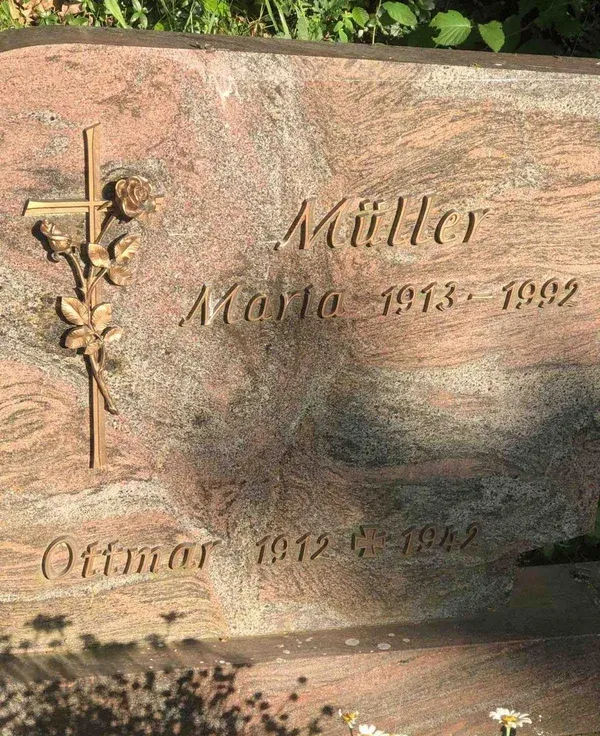
Maria Müller (1913-1992), Obernheim-Kirchenarnbach Cemetery.
Lithuania
Lithuania gives most surnames three forms, for men, married women and unmarried women, and we added the three together. Several leading names are Lithuanian forms of Polish ones. Kazlauskas answers to Kozłowski, from kozioł, "billy goat", and Stankevičius to Stankiewicz. Petrauskas means "son of Petras", Paulauskas comes from Paulius and Adomaitis from Adomas.
A 2015 count of living men put Kazlauskas first, ahead of Jankauskas, Petrauskas, Stankevičius and Vasiliauskas. Our order differs because half of our Lithuanian graves come from Šiauliai County, and the Radviliškis New Municipal Cemetery alone holds 10,383. Adomaitis, fifth, owes 102 of its 113 graves to that county.

Aldona Kazlauskienė (1929-1982), Žagarės Raktuvė New Cemetery. The -ienė ending marks a married woman.
Finland
Finland shares its national leader with us: Korhonen. Behind the Name derives it, with a "possibly", from the archaic korho, "deaf, hard of hearing". Karjalainen means a Karelian, Lehtinen comes from lehti, "leaf", and Virtanen from virta, "stream". Nationally Virtanen is second, followed by Mäkinen, Nieminen and Mäkelä.
In Finland, volunteers photographed a few cemeteries in depth, and 130 of our 217 Korhonens lie at Rautalampi Cemetery, 153 Manninens at Kangasniemi and 124 Karjalainens at Kajaani. Virtanen, spread across 56 cemeteries, is the most even.

Eemil Korhonen (1890-1961), Rautalampi Cemetery.
Denmark, Sweden, Austria, Hungary and Belgium
Scandinavian patronymics pile up on a few names. Nielsen, the son of Niels, appears on 1,961 Danish graves, 6.5% of our sample. Pedersen and Jensen follow, sons of Peder and Jens, and Denmark's 2022 figures put the same names near the top: Nielsen, Jensen, Hansen, Pedersen, Andersen. Our Swedish graves come mostly from Skåne, where Svensson, Nilsson and Persson lead; the national list starts with Andersson, Johansson and Karlsson.
Hungary repeats its national top five (Nagy, Kovács, Tóth, Szabó, Horváth) in a different order. In Austria 8,773 of our 20,784 graves lie in Vorarlberg, which lifts local names such as Wachter and Riedmann into the top ten. Belgium's records are spread so evenly that no surname reaches 50.
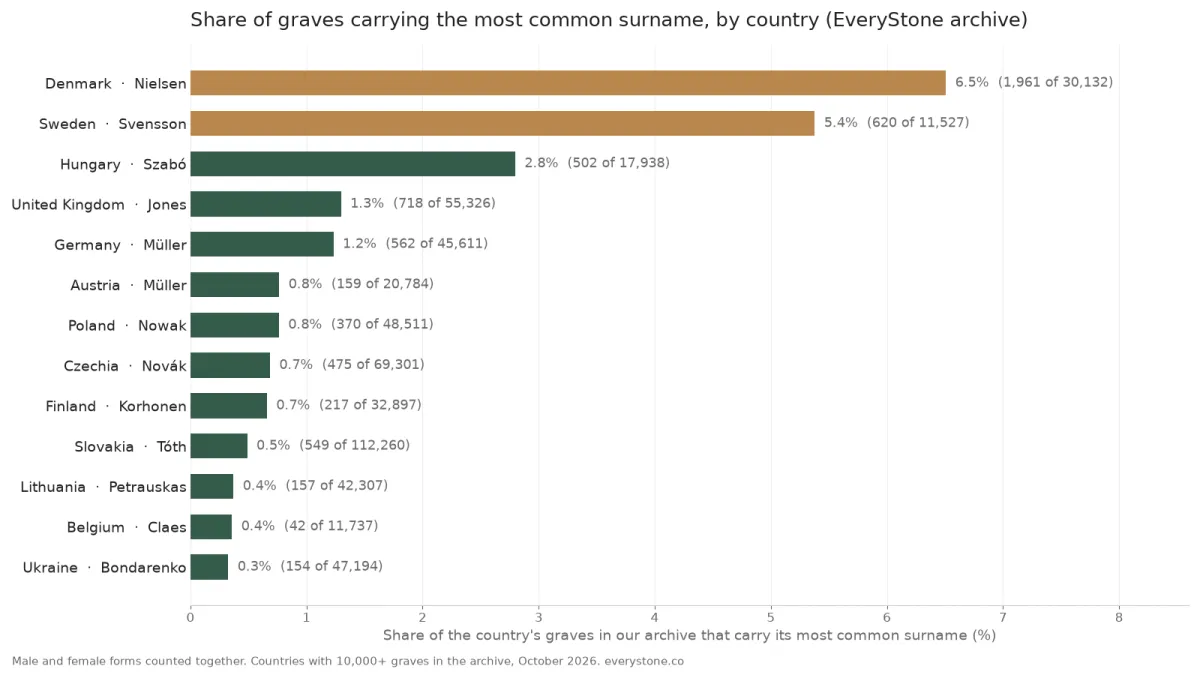
Share of graves carrying each country's most common surname, male and female forms combined. In Belgium, Gérard ties with Claes.
Finding your own surname
Our counts show where a name gathers and also where our photographers have worked. If your family name is a Novák, a Kowalski or a Bondarenko, search for it in the EveryStone archive, then open the cemeteries around your ancestors' village: the stone that names them may already be photographed and mapped.