
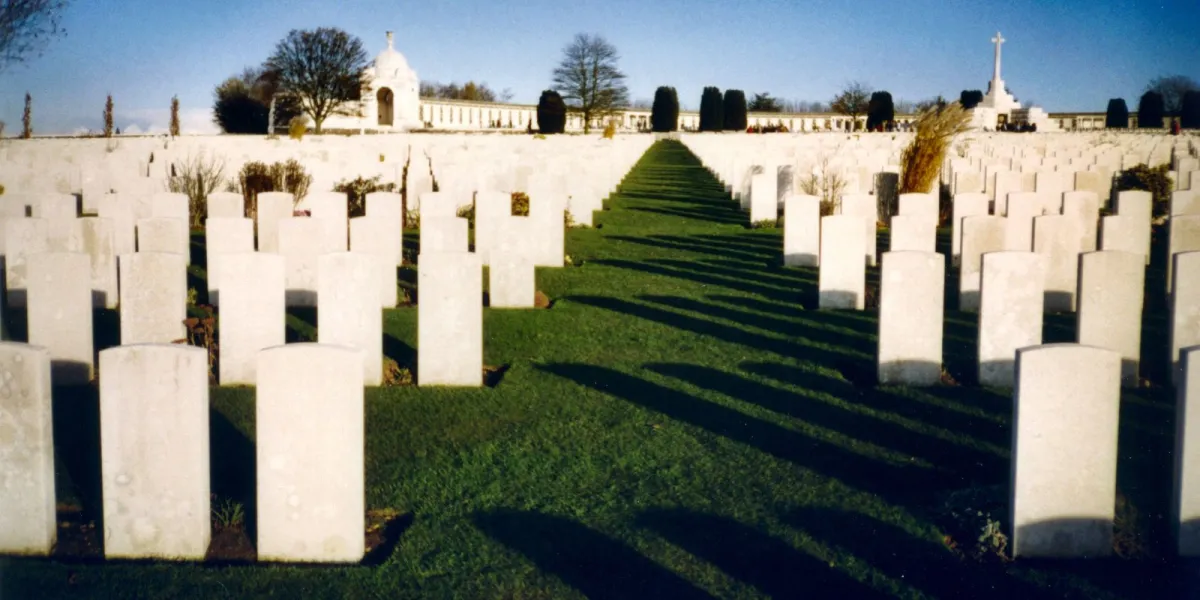
Most families know a little about their soldier of the First World War: a name, a regiment, a year, perhaps a photograph. The grave itself can lie in a Flanders field, on a Polish hillside or under an Alpine pass. Many armies of the war now have an official body or a database that records where their dead lie, and nearly all of them are free to search online.
To find a WW1 grave, start with the database of the army your great-grandfather served in. Each cemetery linked below has a page in the EveryStone archive with its location and a map.
What to gather before you search
Each of these narrows the search:
- Full name and spellings: records mix full names, initials and local spellings. A Polish or Ukrainian name may appear in German, Russian or Hungarian form.
- Unit: regiment and battalion for the British Army, regiment for the French, German and Austro-Hungarian armies.
- Date of death: even a year and a month narrows thousands of matches to a handful.
- Service number: British and Commonwealth records use it to tell men of the same name apart.
- Place and date of birth: the German and French databases let you search by both.
Family papers, medal cards, a local newspaper or a village war memorial can supply most of these.
Which database for which army
| Army | Where to search | What you usually get |
|---|---|---|
| British and Commonwealth | CWGC Find War Dead | Cemetery or memorial, plot, row and grave |
| German | Volksbund Gräbersuche online | Cemetery, grave location where known |
| French | Mémoire des hommes | Death record, and for state-kept graves, the necropolis and grave |
| Belgian | War Dead Register | Biographical record and cemetery |
| Italian | Albo dei Caduti della Grande Guerra | Death record, sometimes the burial place |
| American | ABMC burial search | Overseas cemetery, or name on the Tablets of the Missing |
| Austro-Hungarian | Austrian State Archives | Original burial place, if a death card survives |
British and Commonwealth soldiers: the CWGC search
The Commonwealth War Graves Commission's Find War Dead search covers the 1.7 million Commonwealth men and women it commemorates from both world wars. You search by name and filter by war, service number, regiment, country and date of death. The CWGC's own research guide advises trying several forms of a name, because records use full names, a name and initial, or initials only.
A result gives the cemetery or memorial and a grave reference. Below it sit scans from the Commission's archive: grave registration reports, headstone reports with the personal inscription the family chose, and concentration reports for men moved from small battlefield graves into larger cemeteries after the war.
Because of concentration, many soldiers lie far from where they fell. Ancre British Cemetery on the Somme held 517 men at first and grew to 2,541 burials once graves from many smaller sites were brought in. Tyne Cot Cemetery near Passendale holds roughly 11,950 burials and commemorations, while Essex Farm Cemetery north of Ypres, begun by a medical unit in 1915, holds 1,199 servicemen, 102 of them unidentified.
German war graves of WW1
The Volksbund Deutsche Kriegsgräberfürsorge runs the Gräbersuche online, which covers the German dead and missing of both world wars. In 2026 its counter passed 5.4 million names, and the Volksbund expects to add about 450,000 more. You need at least a first name, a surname or a place of birth, and you can add dates of birth and death. Where the Volksbund knows the grave, the record names the cemetery and the grave's position in it, with a map and a description of the site. If a man is missing from the database, you can send the Volksbund an enquiry form.
German graves of the Western Front were gathered into a small number of large cemeteries, often with mass graves. At Langemark the mass grave holds 24,917 dead, the largest on any German soldiers' cemetery. At Vladslo, 25,644 soldiers lie under flat stones that each carry twenty names. In France, the Rancourt German War Cemetery holds 11,422 men, 3,930 in individual graves and 7,492 in an ossuary. If your soldier's record points to an ossuary, his name may stand on a plaque with no grave of his own.
French soldiers
The French Ministry of the Armed Forces publishes two databases on Mémoire des hommes. The first holds the cards of more than 1.3 million soldiers of the Great War who received the mention "Mort pour la France", with date, place and circumstances of death. The second, Sépultures de guerre, lists about 700,000 people buried in national necropolises, communal military plots and military cemeteries abroad that the state maintains. The ministry warns that the original cards often contain errors in the spelling of names and in grave numbers.
A French soldier may also lie in his home village. From 1920 families could ask for a body to be returned, and between about 250,000 and 300,000 were. Those graves sit in ordinary communal cemeteries, and no national register lists them, so the parish or town hall is the place to ask. National cemeteries such as Rancourt on the Somme, with more than 8,500 French soldiers, hold the men who stayed at the front.
Belgian soldiers
The War Heritage Institute runs the Belgian War Dead Register. For the First World War it counts as fallen anyone who died between 4 August 1914 and 30 September 1919, and it also lists men buried in military plots who died outside those dates. Entries give personal details and the cemetery, and most include the soldier's original file from the war graves department. Many Belgian soldiers lie in small plots of honour, such as the Halen Belgian Military Cemetery, where 181 Belgian soldiers of the war rest beside the municipal cemetery of Velpen.
Italian soldiers
The Albo dei Caduti della Grande Guerra, compiled by the Associazione Storica Cimetrincee under the patronage of the Ministry of Defence, puts online every soldier listed in the 28 volumes and three Veneto appendices of the official Albo d'Oro. The official roll does not give burial places. The site adds them where volunteers have found them and warns that remains may since have been moved to a shrine, so check before you travel. Many Italian dead now lie in large ossuaries such as Pocol above Cortina d'Ampezzo, at 1,535 metres. Italy also sent 41,000 troops to France in 1918, and Bligny in the Marne shelters 3,440 Italian soldiers, 400 of them in an ossuary.
American soldiers
The American Battle Monuments Commission's burial search covers its overseas cemeteries and the names on its Tablets of the Missing. About 31,000 Americans of the First World War lie in ABMC cemeteries, and about 4,450 names stand on the Tablets. The database does not include men whose families had them brought home for burial in the United States. The Somme American Cemetery at Bony, in the Aisne despite its name, holds about 1,839 men and 5 women, 138 of them unknown.
Austro-Hungarian soldiers and the West Galician cemeteries
Austria-Hungary has no single database, and the Austrian State Archives hold no complete register of the empire's war dead. Their death card index, which FamilySearch has put online, gives the original burial place for the men it covers, and the archives keep files on front-line cemeteries arranged by theatre of war. Later reburials are not recorded, and for those the archives refer researchers to the Austrian Black Cross.
In southern Poland, the battles of 1914 and 1915 left about 400 West Galician war cemeteries, built by the war graves section in Kraków and known by number. Gorlice War Cemetery No. 91, designed by Emil Ladewig, stands on a hill that was a key defensive position in the 1915 battle. At Łużna-Podbrzezie War Cemetery No. 120, 416 or 417 men of six Honvéd regiments, mostly Hungarians killed in April and May 1915, lie in 27 mass graves and 115 single ones. These cemeteries often hold soldiers of opposing armies side by side. The Kraków museum's Eastern Front trail maps many of them.
Russian soldiers and the Eastern Front
Records for the Russian army are the thinnest. In 2017 the Russian Ministry of Defence opened a portal, "In Memory of the Heroes of the Great War 1914-1918", built from casualty files in the State Military Historical Archive, with more than 2 million people at launch. It holds records of the killed, the wounded and the decorated. Russian soldiers often lie in shared cemeteries in Poland, such as the Wiączyn War Cemetery on the edge of Łódź, which holds German and Russian dead of the Battle of Łódź in 1914. Russian brigades also fought in France, and more than 900 of their men rest in the Russian Military Cemetery at Saint-Hilaire-le-Grand in the Marne.
Reading a grave reference
A CWGC reference such as "XIV. D. 12A." means Plot XIV, Row D, Grave 12A. Plots carry Roman numerals and rows carry letters. A reference that reads "Panel" followed by numbers points to a memorial wall: the man has no known grave. Other armies use their own systems. French Sépultures de guerre records give the necropolis and a grave number, and Volksbund records give the cemetery and, where known, the grave's position.
Unknown soldiers and memorials to the missing
Many men were never identified. The CWGC marks an unidentified grave with the words chosen by Rudyard Kipling, "Known unto God", and records the man's name on a memorial to the missing. The Menin Gate at Ypres carries more than 54,000 names of men who died in the Salient; for British soldiers it lists those killed before 16 August 1917. Later British losses there appear on the memorial wall at Tyne Cot. The Thiepval Memorial on the Somme carries more than 72,000 names of British and South African soldiers with no known grave. The Arras Memorial commemorates nearly 35,000 men of the United Kingdom, South Africa and New Zealand from the Arras sector.
Visiting the grave
- Write down the full reference: cemetery, plot, row and grave, or the panel number. Large cemeteries hold thousands of identical stones.
- Check for registers: many larger CWGC cemeteries keep a register and a plan of the plots in a small cupboard by the entrance.
- Plan for remote sites: some West Galician and Alpine cemeteries sit on hilltops or mountain passes, so check the route on the map before you set off.
- Bring a camera: a photograph of the stone lets relatives who cannot make the trip read it.
How EveryStone helps
Every cemetery linked here has a page on EveryStone with its outline on a map, GPS coordinates of the site and directions. Where volunteers have photographed headstones, the page lists those graves with their own GPS points, so you can walk straight to the right row. Most war cemetery pages have no individual graves yet. If you visit, you can photograph a headstone and add it to the archive.
You can browse the EveryStone archive by country, including France, Belgium, Italy, Germany, Poland and the United Kingdom, and find the war cemeteries near the place where your soldier fell.