
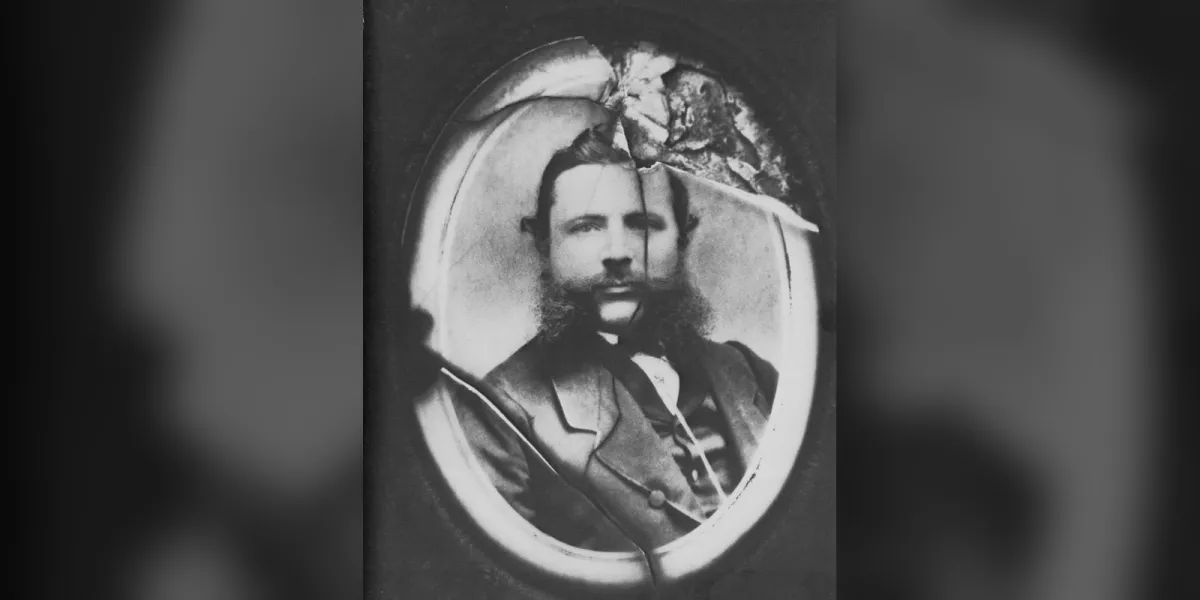
In a Ukrainian village cemetery, most graves show the dead person's face. Sepia ovals hang on painted metal crosses, and faces are engraved in black granite above the names. Cross the border into Slovakia or Poland and most stones carry only a cross above names and dates.
We wanted to measure that difference with our own photographs. EveryStone holds headstone photos for more than 300,000 graves in Ukraine, Czechia, Slovakia, Poland and Lithuania, so we sampled them country by country and counted the faces.
How we counted
The archive has no "portrait" field, so we looked. For each of five countries we drew 340 graves at random from the records that have at least one approved photo, took one photo per grave and dropped repeats of the same file. We viewed every image on contact sheets and opened the full photo whenever a stone was too small to judge. Each stone got one label: a photo-ceramic or enamel portrait, a portrait engraved into the stone, another kind of portrait, an empty frame where a photo used to be, or no portrait at all.
Of 1,695 photos, 75 showed too little of the stone to judge, which left 1,620. The figures describe graves in our archive and nothing wider. Our photos come from different surveys in each country, and in a wide shot of a family plot a small oval can escape notice, so the lower figures are more likely to be too low than too high.
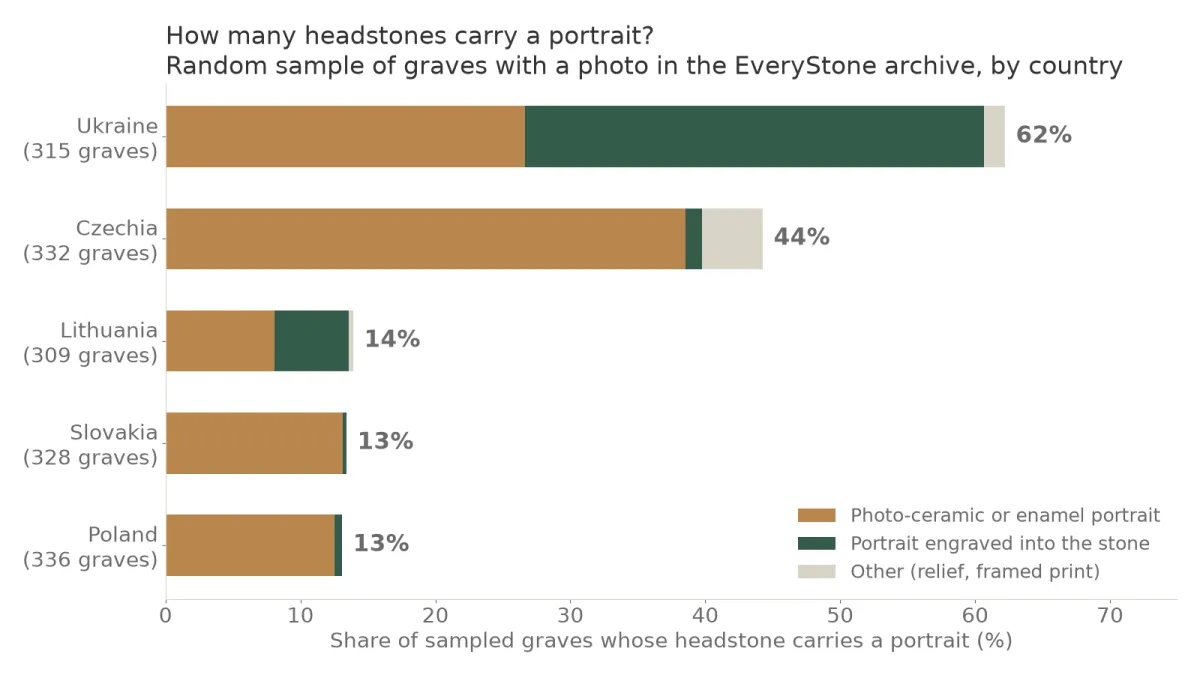
Share of sampled graves whose headstone carries a portrait, split by type. Between 309 and 336 readable photos per country.
In Ukraine, 196 of 315 graves (62%) show a face. In Czechia the figure is 147 of 332 (44%). Lithuania, Slovakia and Poland sit together at 13% to 14%. The type of portrait also differs by country: Ukraine has 107 engraved portraits, Lithuania 17, while Czechia, Slovakia and Poland together have nine in 996 graves.
Photographs fired onto porcelain
Photo-ceramic portraits date from the 1850s. The Frenchman Lafon de Camarsac (1821-1905) invented a process in 1854 for printing photographic images onto porcelain, and the Victoria and Albert Museum holds a cup and saucer from the "unchangeable photographs on enamel and porcelain" he showed in London in 1862. Fired in a kiln, the image became part of the glaze, so it could stand outdoors in sun and frost for decades. In the cemeteries we photograph, the usual form is an oval with a white or black rim, set into the stone or screwed to a cross.
In our Ukrainian sample the oval peaks with deaths from 1970 to 1989: 30 of the 69 graves from those years carry one. Many sit on modest monuments: terrazzo slabs, iron crosses and painted metal obelisks. Some workshops fired the photo and the inscription onto one enamel plate and tinted the face and the background, as on the plate of Ivan Marchenko in Pohreby, where his portrait sits against a painted blue sky beside his name and dates.
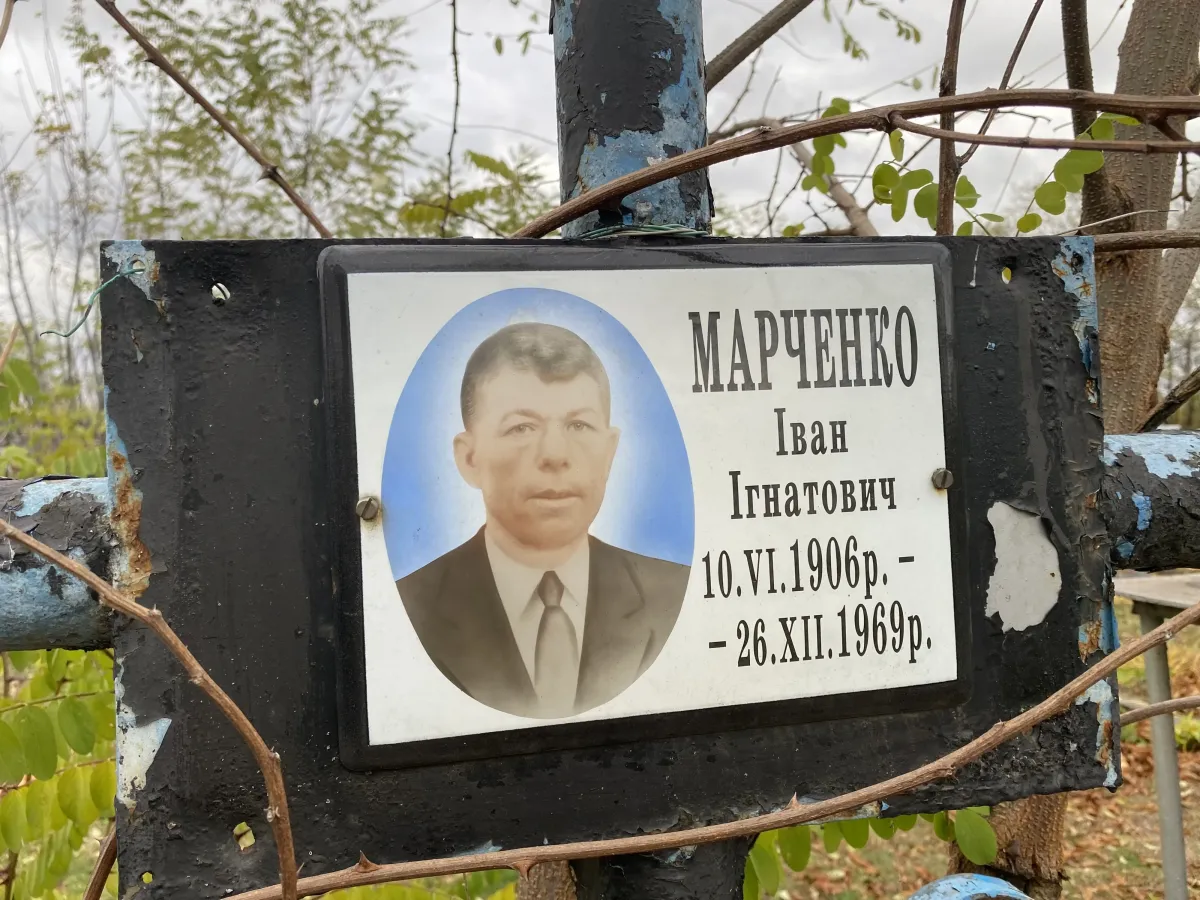
Ivan Marchenko (1906-1969), Pohreby Cemetery, Kyiv Oblast: a tinted photograph and the inscription fired onto one enamel plate, wired to a metal cross.
Eight stones in the main sample show only an empty recess or a bare frame where an oval was once glued, and on others the image has faded to a pale ghost. On a concrete stone in Khmelnytskyi, the name plate of Elena Maslovskaya (1906-1991) is intact, while the oval above it holds nothing.
Black stone and a diamond needle
The second style needs no photograph on the stone at all. An engraver copies the photo onto polished black stone, dot by dot, with a hard point; each blow leaves a pale mark, and the dots build up a face in shades of grey. In 1997 the Seattle Times visited a Ukrainian engraver in Oregon who had carved such portraits in Ukraine before he emigrated. He worked with hand tools he had brought with him and needed thousands of taps for one face. Workshops today also use machines that transfer a scanned photograph onto the stone.
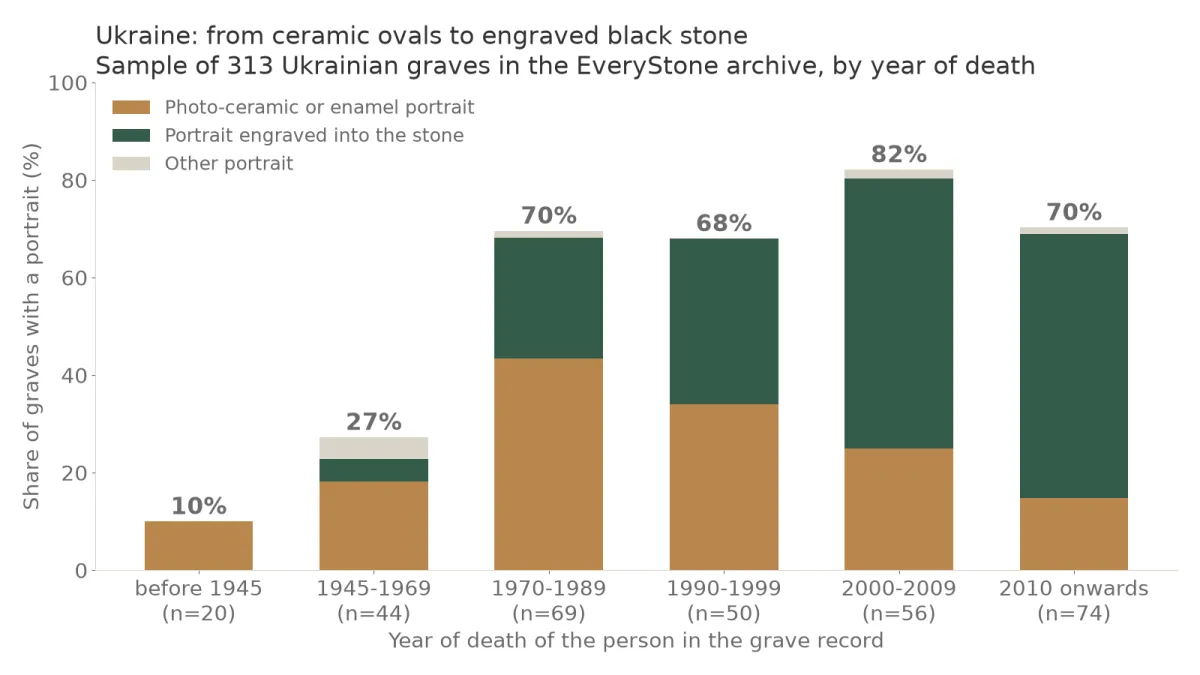
Ukrainian graves in our sample by the year of death in the record, 313 graves with a known year. The groups are small, from 20 to 74 graves each.
In Ukraine, for deaths from 1970 to 1989, ceramic ovals outnumber engravings 30 to 17. For deaths from 2000 onwards, engraved portraits appear on 71 of 130 graves and ovals on 25. The year of death is not the year of the stone, since families often replace a monument long after a funeral, so the chart shows what stands in the cemetery today.

Andrey Buryma (1920-1997), Kinski Rozdory Cemetery, Zaporizhzhia Oblast.
Lithuania follows the same pattern on a smaller scale, with 25 ceramic portraits and 17 engraved ones among 309 graves. Several of its older engravings sit on grey granite rather than black, where the stippled faces look softer.
Two faces, one stone
Half of the stones with a portrait in our sample, 238 of 474, show two or more people. In Czechia the share reaches 116 of 147, because family graves there often gather two or three generations behind one plaque. Couples are the most common pair, and their deaths can lie decades apart: on a terrazzo stone in Zaporizhzhia, Andrey Konoval died in 1958 and Mariya Konoval in 1990, and their ovals hang side by side.


Left: Andrey Konoval (1912-1958) and Mariya Konoval (1909-1990), Kapustyaniy Cemetery, Zaporizhzhia. Right: Adam Kozakiewicz (1905-1971) and Aleksandra (1912-1989), Račkūnai Cemetery near Vilnius.
The Kozakiewicz stone in Lithuania shows the couple young, side by side in a single oval. Its plaque is in Polish and ends "Pamiątka od dzieci", a keepsake from the children. In Žagarė, near the Latvian border, Vasilijus Josas and Pranciška Josienė share an engraved stone, his face beside hers.

Vasilijus Josas (1913-1982) and Pranciška Josienė (1923-1990), Žagarės Raktuvė New Cemetery, Šiauliai County.
Czechia, Slovakia and Poland
In Czechia, ovals appear on 128 of 332 sampled graves, often in rows on a family plaque. Thirteen more graves have framed photographs standing behind glass in a niche in the base, a custom we saw nowhere else in the sample. Engraved portraits appear on only six.
In Slovakia and Poland the portrait remains a minority choice at about one grave in eight, and almost always a ceramic oval: 43 of 44 in Slovakia and 42 of 44 in Poland. Several Slovak ovals sit on a cross or beneath a relief of Christ.

Vlastička Vachajová (1943-1945), Sekule Cemetery, Trnava Region, Slovakia; the stone reads "Here sweetly sleeps little Vlasta".
Faith and the face
We sampled 119 graves in Jewish cemeteries in Ukraine and could judge 102. Of the 34 people who died before 1945, mostly under traditional matzevot carved with Hebrew text, two have a portrait. Of the 68 who died later, 38 (56%) do, ovals on Soviet-era concrete and engraved faces on black stone alike. In the Jewish cemeteries of Bratislava and Prešov in Slovakia, none of the 108 graves we could judge shows a face.
Many Muslim scholars discourage images on graves, yet nine of the 43 graves we hold in the Tatar cemeteries of Raižiai in Lithuania and of Warsaw, Bohoniki and Kruszyniany in Poland carry portraits. Among Christian graves the difference runs by country: largely Catholic Slovakia and Poland have few portraits, Czechia many, and Ukraine, mostly Orthodox and Greek Catholic, the most.
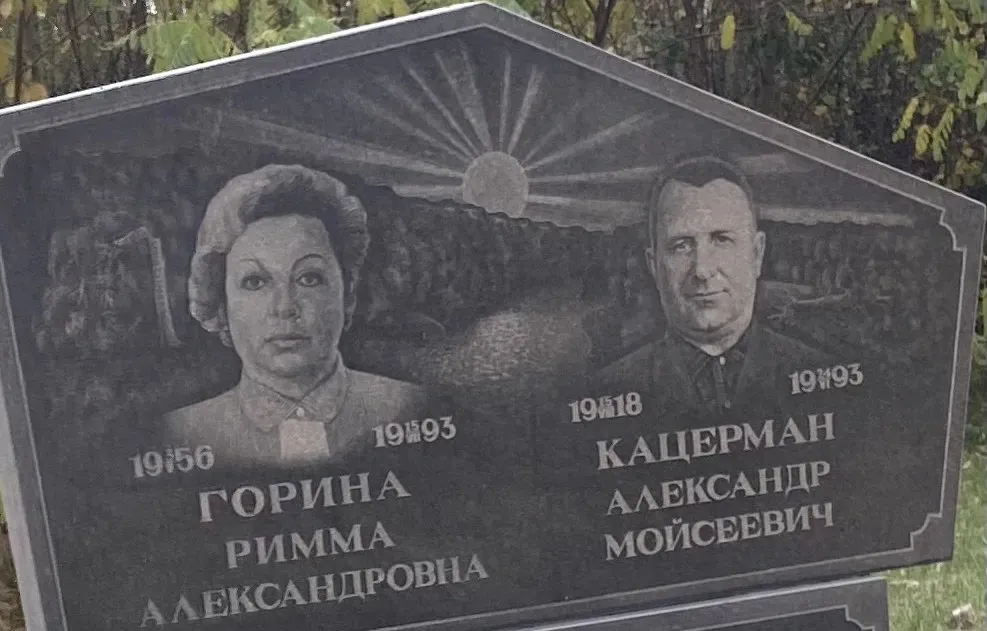
Rimma Gorina (1956-1993) and Aleksandr Katserman (1918-1993), Korsun-Shevchenkivskyi Jewish Cemetery, Cherkasy Oblast.
Finding the faces
A portrait on a headstone can be the only photograph of a person that a family historian will ever find, and the ceramic and enamel ovals of the 1950s to 1980s are fading and falling off. Each grave above has its own page, with photos and dates beside a map location, and so do many thousands more. Browse the cemeteries of Ukraine, Czechia, Lithuania, Slovakia and Poland, and if you know a stone with a face on it, photograph it and add it while the image still shows.