
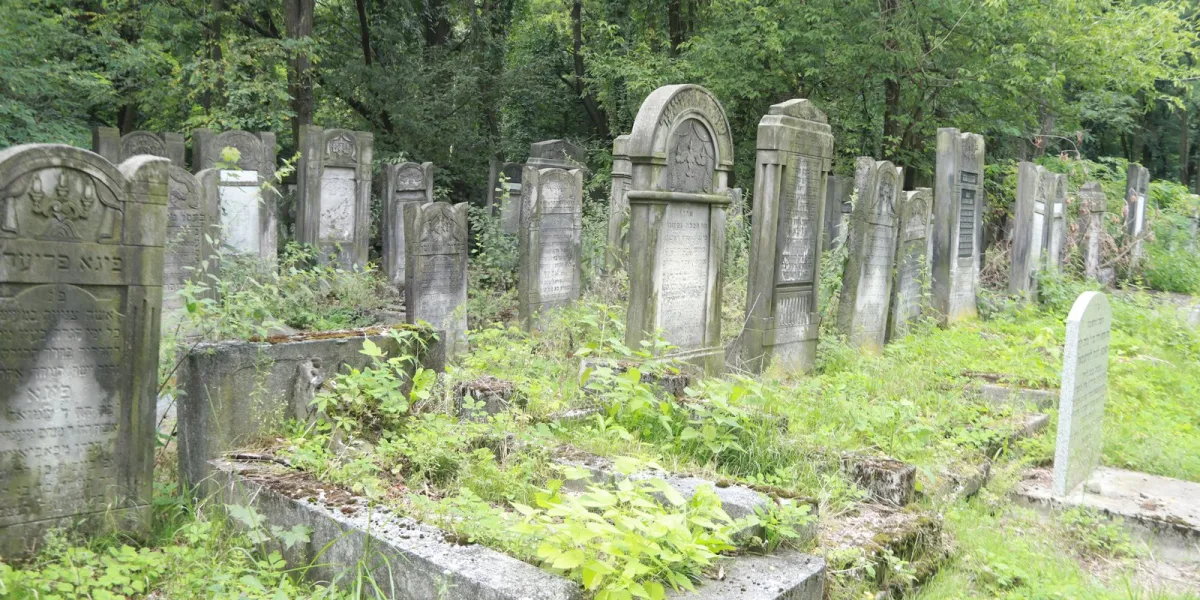
A Jewish gravestone often holds more family history than a civil death record. It names the dead person's father, gives the day of death in the Hebrew calendar, and can show that the family descended from the Temple priests or the Levites. If you trace ancestors in Poland, Czechia, Ukraine or Lithuania, one clear photograph of a stone can take your search back a generation.
The Hebrew word for the stone is matzevah (plural matzevot). In the Hebrew Bible it means a standing stone or pillar, from a root meaning "to stand", and Genesis tells how Jacob set one up over Rachel's grave. Most matzevot in Central and Eastern Europe follow a fixed pattern. Once you know it, a few dozen Hebrew letters and a calendar converter will give you the key facts.
The layout, from top to bottom
An Ashkenazi stone usually runs in this order:
- A carved symbol in the top panel: blessing hands, a pitcher, candlesticks, a crown, an animal.
- The opening formula, two letters: פ"נ or פ"ט.
- The name, with titles, then "son of" or "daughter of" and the father's name.
- The date of death in Hebrew letters, sometimes with the date of burial.
- A eulogy, from one line to a whole poem. In longer ones the first letters of the lines often spell the name of the dead person, an acrostic tradition taken from medieval liturgical poetry.
- The closing formula, five letters: ת.נ.צ.ב.ה.
Marks between letters tell you that something is abbreviated. JewishGen's guide to reading Hebrew tombstones explains that a single apostrophe usually shortens one word, and a double mark (״) a whole phrase.
The opening: פ"נ and פ"ט
פ"נ stands for po nikbar, "here is buried" (פה נקבר), or po nikberah for a woman. Some stones expand the same letters as po nitman, "here is interred". A less common opening is פ"ט, po tamun or po temunah, "here is hidden". All of them mean "here lies". On a worn or broken stone, these two letters show you where the inscription proper begins.
Names: ben and bat
A Hebrew name includes the father's: Yaakov ben Yitzhak is Yaakov, son of Yitzhak. A daughter is bat. On stones the link often appears as ב"ר, ben reb or bat reb, "son (or daughter) of the worthy". Reb is a courtesy title, like "Mr", and does not make the father a rabbi.
The patronymic lets you climb the tree: if you know a great-great-grandfather's name, his stone gives you his father's, and the father's stone, if it survives, gives you the next. A woman's stone names her father, which points to the family she was born into. Names often appear in Yiddish forms, such as Hersh or Leib, beside or in place of the Hebrew Zvi or Arye.
After the name, the word הכהן, ha-kohen, marks a man descended from the priests. The cemetery at Holešov in Moravia, whose oldest identified stone dates from 1647, holds the tomb of Rabbi Shabbatai ha-Kohen.
The Hebrew date
Each Hebrew letter has a number value, and you add the letters together.
| Units | Tens | Hundreds |
|---|---|---|
| א 1 | י 10 | ק 100 |
| ב 2 | כ 20 | ר 200 |
| ג 3 | ל 30 | ש 300 |
| ד 4 | מ 40 | ת 400 |
| ה 5 | נ 50 | |
| ו 6 | ס 60 | |
| ז 7 | ע 70 | |
| ח 8 | פ 80 | |
| ט 9 | צ 90 |
Fifteen is written ט"ו (9 + 6) and sixteen ט"ז (9 + 7), because י"ה and י"ו are written forms of the divine name, as the article on Hebrew numerals explains. Years leave out the thousands, and many stones add לפ"ק, short for li-frat katan, "by the small count", to say so.
Take a line such as נפטר י"ז אדר תרפ"ג לפ"ק, "died 17 Adar 683, small count":
- י"ז is 10 + 7 = 17.
- תרפ"ג is 400 + 200 + 80 + 3 = 683, so the year is 5683.
The Jewish year begins at Rosh Hashanah, in September or October. For dates from January to the end of the summer month of Elul, subtract 3760 from the Hebrew year. For dates from Rosh Hashanah to 31 December, subtract 3761. Adar falls in late winter, so 5683 minus 3760 gives 1923, and Hebcal's converter puts 17 Adar 5683 on 5 March 1923. A death on 10 Heshvan of the same Hebrew year falls in the autumn: 5683 minus 3761 gives 1922, and the date is 1 November 1922. The month of Tevet straddles New Year's Day (1 Tevet 5683 was 20 December 1922, 29 Tevet was 17 January 1923), so run those dates through a converter. The Hebrew day also starts at sunset, so a death in the evening carries the next day's date.
The closing: ת.נ.צ.ב.ה
The last line of most stones reads tehe nishmato tzrurah bi-tzror ha-hayyim, "may his soul be bound up in the bond of life". On a woman's stone the same letters stand for nishmatah, "her soul". The phrase comes from 1 Samuel 25:29, and some stones use nafsho in place of nishmato with the same meaning.
Symbols carved on the stone
Start with the symbol in the top panel. It can tell you the dead person's descent, sex, learning or name.
- Blessing hands, with the fingers parted in pairs: the priestly blessing, marking a Kohen, a descendant of Aaron. Families named Kohen, Kohn, Kahan or Kahane often carry it.
- A pitcher, sometimes with a basin: a Levite, whose ancestors washed the priests' hands in the Temple.
- Candlesticks: a woman, who lit the Sabbath and festival candles.
- A broken tree, a snapped branch or a broken candle: a life cut short, often a young person.
- Books or a Torah scroll: a scholar or rabbi.
- Animals: often a play on the name. The Jewish Museum in Prague lists the lion for Loew and the deer for Hirsch, and a bear stands for Dov or Ber.
My Jewish Learning keeps a fuller catalogue, from the crown to the lulav. Carved stones survive at Ożarów, where about 100 matzevot show varied ornament, and at Przytyk, where about 30 decorated stones include a double tombstone for Rabbi Samuel Zajnwel and his son. At Siret in Romania, often called the oldest Jewish cemetery in Eastern Europe, many stones carry Hebrew motifs and the oldest dates from 1560.
Languages
A study of epitaphs from Belarus and Ukraine by the scholar Michael Nosonovsky found them almost always in Hebrew, with Yiddish showing through in the spelling of names. A count of the stones at the Older Jewish Cemetery in Eisenstadt in 1922 found all 1,140 inscribed in Hebrew only. From the middle of the 19th century German spread onto stones in German lands, usually for parts of the text and seldom as a full translation of the Hebrew. Further east the second language is Polish in Galicia and Russian in the former Russian Empire. The civil name and the Hebrew name can differ, so record both.
Small stones on the matzevah
Visitors to Jewish graves leave pebbles on the stone, and rarely flowers. The origin of the custom is unknown. The common explanation is that a pebble shows someone came and remembered. My Jewish Learning ties it to the closing formula: tzror, the "bond" of ת.נ.צ.ב.ה, also means a pebble, and shepherds once kept count of their flock with pebbles in a pouch.
The ohel over a rabbi's grave
Over the grave of a famous rabbi, above all a Hasidic tzaddik, followers built an ohel, Hebrew for "tent": a small masonry house where pilgrims pray, light candles and leave kvitlech, slips of paper with requests. At Rymanów two ohels shelter Menachem Mendel (1745-1815) and Zvi Hirsch Cohen (1788-1847). Bobowa has the ohel of its tzaddikim and a section for Jewish soldiers of the First World War. In Bratislava the Chatam Sofer Memorial stands on the site of the city's oldest Jewish cemetery, destroyed in 1944; the underground memorial by the architect Martin Kvasnica holds the tomb of the scholar Chatam Sofer (1762-1839) and 22 other graves.
Where to practise
The Old Jewish Cemetery in Prague, in use from about 1439 to 1787, packs around 12,000 stones into layers of burials, and visitors still leave notes at the Renaissance tomb of Rabbi Loew (died 1609). The Old Jewish Cemetery in Mainz has almost 1,700 historic stones and, with the Heiliger Sand in Worms, is often called the oldest Jewish cemetery in Europe. It has been part of the UNESCO World Heritage SchUM sites since 2021. Třebíč holds about 2,600 stones, the oldest legible one from 1631. In Krosno the graves stand in rows with separate sections for men and women.
What happened to the cemeteries
The ESJF European Jewish Cemeteries Initiative counts about 10,000 known Jewish cemetery sites in the 46 member states of the Council of Europe, three quarters of them in Central and Eastern Europe. In the Holocaust the Germans murdered the communities that owned them, and decades of neglect and vandalism followed, as gravestones went off for building. In Nowy Sącz the Germans removed most of the matzevot, some reused as paving, and at Ożarów stones hardened roads. Where fragments came back, towns and communities set them into lapidaria: walls or fields of rescued stones. Ostrów Wielkopolski built one in 2008 on the outline of its first Jewish cemetery. Other cemeteries survived in larger part. The Jewish Cemetery of Chernivtsi, founded in 1866, is often called the largest by area preserved in Europe, and Darbenai in Lithuania keeps gravestones with Hebrew inscriptions behind a concrete wall.
Visiting with respect
- Cover your head if you are a man. Prague's museum requires it at the Old Jewish Cemetery, and most communities expect it.
- Avoid the Sabbath and Jewish holidays. By custom Jews do not visit graves then, and many cemeteries stay locked.
- Keep to the paths and do not step on graves. By tradition, Kohanim avoid contact with graves.
- Read by raking light. Low sun or a torch held to one side brings out worn letters; chalk and rubbing harm the stone.
- Take nothing away. Leave a pebble if you wish, and many visitors wash their hands on leaving.
Every cemetery named here has a page in the EveryStone archive, with its location and history, and many more Jewish cemeteries are listed under Poland, Czechia, Germany, Ukraine, Lithuania, Slovakia, Romania and Austria. If you photograph a matzevah on a visit, add it to the archive, where a descendant searching for that name may find it.